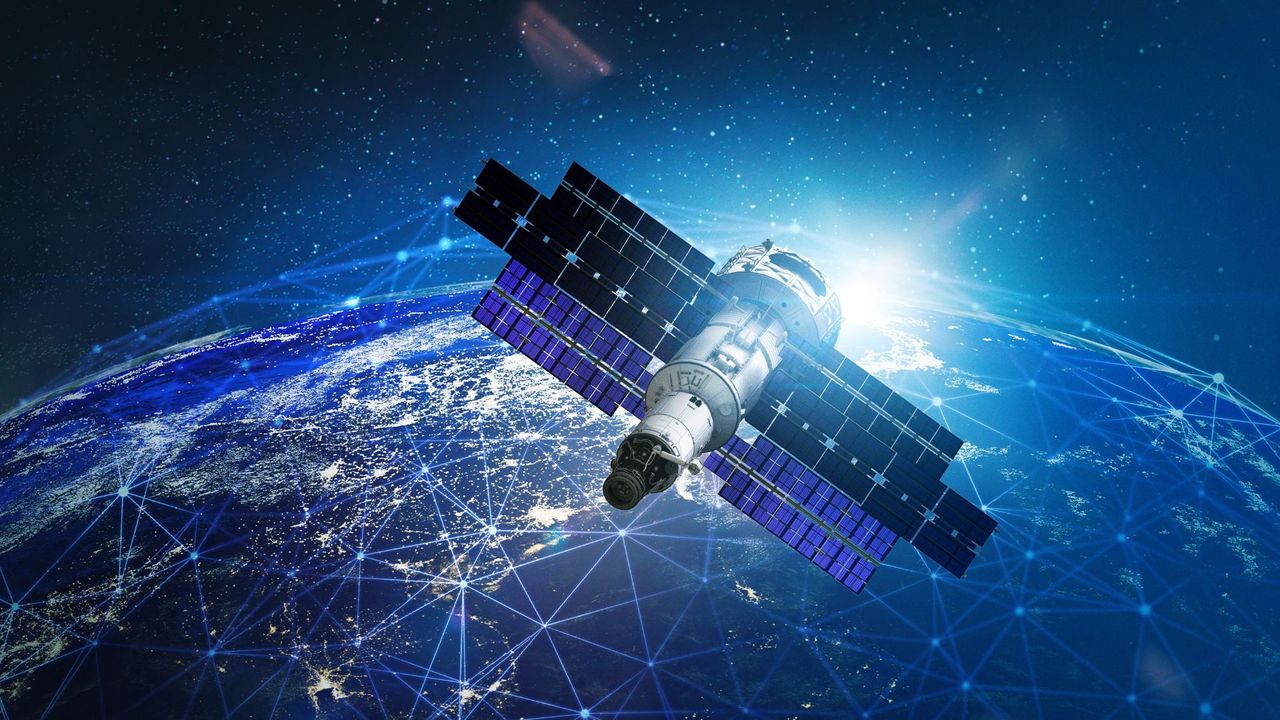
The European Space Agency, along with partners TNO and TESAT, has successfully established the world's first gigabit-speed laser link between an aircraft and a geostationary satellite. The test achieved a 2.6 Gbps data transfer for several minutes with zero errors, overcoming significant challenges like distance, aircraft movement, and atmospheric conditions.
This milestone advances laser communication as a potential mainstream successor to radio for satellite links, promising high-speed internet for aircraft. Laser technology offers faster speeds and avoids the congestion issues plaguing radio frequencies.
The achievement occurs amid a surge in satellite launches, which is increasing radio frequency traffic. This makes the development of alternative, high-bandwidth communication systems like laser links increasingly critical for future connectivity.
Main topics: Satellite laser communication, record data transfer speed, technological achievement and challenges, future applications for aircraft connectivity, comparison to radio frequency limitations.
Europe achieves record-breaking gigabit per second data transfer between a geostationary satellite and an aircraft
Laser communication could be a mainstream successor to radio communication.
Get Tom's Hardware's best news and in-depth reviews, straight to your inbox.
You are now subscribed
Your newsletter sign-up was successful
The European Space Agency (ESA), Netherlands Organization for Applied Scientific Research (TNO), and German payload manufacturer TESAT have created the world's first gigabit per second laser link between an aircraft and a geostationary satellite. In a blog post from ESA, a transmission of 2.6 Gbps was achieved for several minutes with zero errors.
The test was conducted in Nimes, France, using an aircraft terminal connected to the Alphasat TDP-1 satellite orbiting Earth 36,000 km above the surface. ESA reports that achieving accuracy at such a distance — with a fast-moving aircraft, while dealing with clouds and changes in atmospheric conditions — is a huge challenge.
The test is a huge achievement for ESA's laser-based communication, and brings the technology one step forward to becoming a mainstream solution for satellite communication for aircraft. François Lombard, Head of Connected Intelligence at Airbus Defence and Space, claims that this milestone will open the door for future laser satellite communications, for both commercial and military use, "in the next decades." Having laser-based communication between satellites and aircraft will open the door to having high-speed internet — with speeds competitive with outgoing fiberoptic internet service providers on the ground — on aircraft.
This type of capability is something that has been impossible to accomplish with radio-based satellites. Lasers operate at significantly faster speeds than radio waves, and their narrow beams enable satellites to bypass radio frequency slowdowns affected by the increasingly congested radio waves flooding the world.
Laser-based satellites exist, but haven't been able to generate Gbps bandwidth at such great heights, nor with aircraft serving as the base connection on earth. The TeraByte InfraRed Delivery (TBIRD) satellite was able to achieve a whopping 200 Gbps data transfer — but only at an orbit of just 530 km above the surface.
ESA, TNO, and TESAT's record-breaking 2.6 Gbps transmission comes at a time when satellite launches are becoming increasingly more abundant — and will further increase radio frequency traffic in space. In 2026, SpaceX plans to launch over 1 million satellites to build an "Orbital Data Center system." Furthermore, SpaceX is looking to launch 15,000 new Starlink V2 satellites that will have 5G capabilities with "100x the data density" of its outgoing Starlink infrastructure.
Follow Tom's Hardware on Google News, or add us as a preferred source, to get our latest news, analysis, & reviews in your feeds.
Get Tom's Hardware's best news and in-depth reviews, straight to your inbox.
Aaron Klotz is a contributing writer for Tom’s Hardware, covering news related to computer hardware such as CPUs, and graphics cards.
 Meridiano