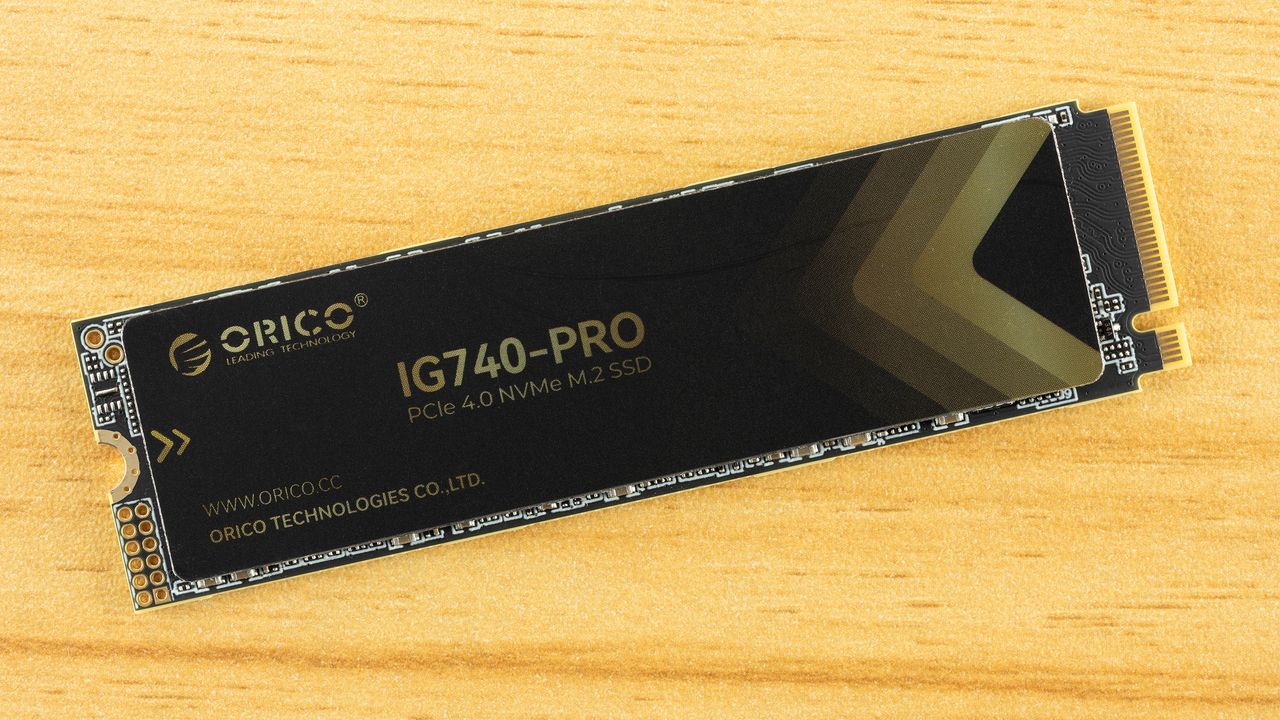
The Orico IG740-Pro is a budget M.2 SSD that delivers solid all-around performance and very good power efficiency, running relatively cool. However, it uses somewhat dated hardware and faces stiff competition in its market segment.
A significant point of uncertainty is that, while marketed with TLC flash and a corresponding endurance warranty, some variants of the drive (particularly the 1TB model) have been reported to ship with QLC flash instead. The drive's availability and pricing are also noted as potential concerns.
The main topics covered are the SSD's performance profile, its power efficiency, the variability of its internal hardware (flash memory type), and its market positioning as a budget drive.
Tom's Hardware Verdict
The Orico IG740-Pro is a solid drive with good performance and power efficiency, but it uses older hardware in a difficult market.
Pros
- +
Good all-around performance
- +
Very good power efficiency
- +
Decent capacity range
Cons
- -
Hardware is a little dated
Why you can trust Tom's Hardware
Orico is not a new name in the SSD game, but it’s probably better known for its portable SSDs and enclosures. Can it deliver a decent, regular M.2 SSD drive? The IG740-Pro is proof that it can – and it produces relatively good results even at just 1TB. It’s off the beaten trail, but it is worth a second look.
Orico actually sells many SSDs, but we have not had the opportunity to review any until now. The company has, on the whole, a mixed reputation with good marks for portables but more uncertainty with its regular M.2 SSDs. This is not surprising as many manufacturers are following the Kingston NV3 trend of selling budget drives with variable hardware, meaning the manufacturer will change the flash and SSD controller used multiple times in the product's lifetime. In fact, we’ve heard of the IG740-Pro coming with QLC flash at 1TB, but our sample arrived with TLC. Orico’s decent warranty – specifically, the endurance rating – backs up the idea that this is intended to be a TLC-based drive.
The good newsis that the IG740-Pro has decent performance and power efficiency. Better than expected, if anything, although in general it’s within the range of other drives in its class. It’s not quite as sporty as newer drives like the Crucial P310 and SanDisk WD Blue SN5100, but its baseline characteristics are great for a budget drive. We particularly like that we got to test a 1TB sample, as manufacturers usually focus more on the 2TB capacity. We don’t see this drive having issues in any system, thanks to how cool it runs, but if you want DRAM on your SSD or the very best performance, then it might disappoint. We also have concerns about availability and pricing for the drive, but if you catch it in stock and on sale, it should be a safe pick-up.
Orico IG740-Pro Specifications
The Orico IG740-Pro comes in 512GB, 1TB, 2TB, and 4TB flavors. This is a decent capacity range, but we would generally not mention the 512GB SKU, and it might be impossible to find, anyway. That capacity is getting harder to support with denser flash, although market changes and some relatively recent flash news – like Kioxia’s/SanDisk’s BiCS9 going back to fewer layers and smaller dies – might change this. Flash is always the most expensive part of a drive, but right now the ratio is much higher than usual. Speaking of expensive, the IG740-Pro is not currently listed for sale in the U.S., but the 1TB should be going for under $150, which would be the current $156 for the Biwin Black Opal NV7400 and closer to the $145 for the Lexar NQ780.
The drive can reach up to 7,450 / 6,500 MB/s for sequential read and write workloads, which is pretty close to the limit of the PCIe 4.0 interface. The drive also reaches up to at least 1,000K / 800K random read and write IOPS. The exact limit is in this ballpark, but honestly, it’s plenty fast for its class of drive. Orico backs it with a five-year, 600TB of data written per TB of capacity (TBW) warranty, which is interesting. This is standard for drives with TLC flash; however, this drive – at least at 1TB – has been reported as also coming with QLC flash.
So, why would Orico have this TBW regardless of flash type? Well, a set TBW can make flash swapping easier if the specification is low enough, and while we have only heard that the 1TB model can come with QLC flash, the 512GB would almost certainly be TLC, for what it’s worth, the 2TB and 4TB models could technically come with QLC as well. The fact is, YMTC’s 232-Layer QLC flash has enough endurance to reach this TLC-level of TBW. Luckily, flash wear should be the least of your worries with a consumer drive and a five-year warranty unless you’re doing enterprise-level workloads. In that case, you really shouldn’t be looking at a 1TB, off-the-shelf, QLC-based, DRAM-less drive in the first place, but if, for some reason, you are, then 600TBW per TB is still a decent amount of writes. Plus, we have no hard evidence to indicate Orico has made any such switch.
Orico IG740-Pro Software and Accessories
If you’re looking for health and general drive information, we recommend the free CrystalDiskInfo utility. It will quickly give you information like the amount of writes to the drive, link width and speed, firmware revision, and more. For data backup and drive cloning on Windows, the free MultiDrive is an excellent choice. For a bootable solution or other operating systems, Clonezilla remains the standard.
Get Tom's Hardware's best news and in-depth reviews, straight to your inbox.
Orico IG740-Pro: A Closer Look
The IG740-Pro is a single-sided drive, which is nice. This makes it compatible with a wider range of systems and can make cooling easier. The label states that the drive is rated for 3.3V at 1.5V, which is around 5W, although there will usually be 5%-10% variance for voltage. Usually, we recommend not going by the label for power usage because it can be inaccurate. Most typically, it is too high or generous, although in this case, that’s too low if you’re going by power states. The drive pulls up to 6.50W in its highest power state according to SMART. However, the SMART value is also very often off and is likewise usually too high. This is confirmed in our power testing, where the drive was below 4W at its highest draw. The lesson here is that you really should check reviews that test power to know what a drive pulls in reality.
The controller here is the Maxio MAP1602, which is a four-channel, DRAM-less part. It can saturate a PCIe 4.0 link, and in general, it has good performance and power efficiency. The revision here, F3C, means that it can also handle higher amounts of flash, which makes sense for the 4TB SKU of the IG740-Pro. There is less to go on for the flash, but the coding tells us it’s YMTC, and digging deeper, we find it’s 232-Layer TLC. We’ve seen this hardware many times, like on the Lexar NM790.
With QLC flash, if there is any swap, it would be closer to the HP FX700. The FX700 actually isn’t bad, but it would feel even more dated against drives with the newer BiCS8 QLC – see the SanDisk Blue SN5100, a.k.a. the Optimus 5100.
MORE: Best SSDs
MORE: Best External SSDs
MORE: Best SSD for the Steam Deck
Shane Downing is a Freelance Reviewer for Tom’s Hardware US, covering consumer storage hardware.
 Meridiano