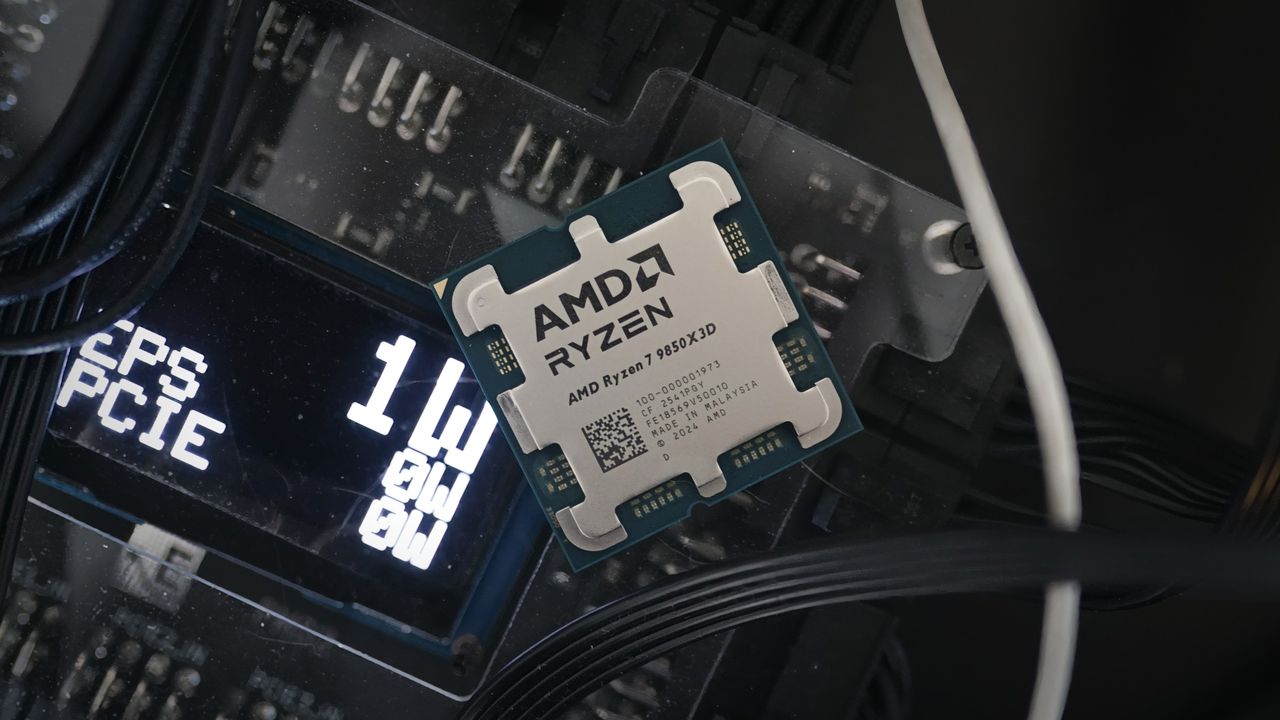
Both AMD and Intel report a significant spike in CPU demand driven by the needs of agentic AI, with customers seeking long-term supply agreements. This surge is part of a broader component shortage that began with GPUs and has since expanded to affect memory and storage.
The shift toward agentic AI requires data centers to use more multi-processor systems combining CPUs, GPUs, and NPUs, increasing demand for server CPUs. While the current discussion focuses on data center demand, a prolonged shortage could eventually impact supply for consumer PC components.
The main topics covered are the increased CPU demand from AI, broader component shortages (GPUs, memory, storage), and the potential for market-wide supply impacts.
‘CPUs are cool again,' Intel and AMD reporting spikes in CPU demand due to agentic AI, shortages — Lisa Su says business exceeded expectations while Intel is looking at long-term agreements with potential customers
Are we staring down the barrel of an AI-driven CPU shortage?
Get Tom's Hardware's best news and in-depth reviews, straight to your inbox.
You are now subscribed
Your newsletter sign-up was successful
Both AMD and Intel said during the 2026 Morgan Stanley Technology, Media & Telecom Conference that demand for CPUs is seeing an uptick due to artificial intelligence. Intel CFO David Zinsner said during his question and answer (via Investing.com) that “the CPU has become cool again this year,” especially as AI agents need CPUs to orchestrate the computationally-heavy tasks that the GPUs and NPUs will execute. It has even started seeing customers who are looking at long-term agreements, ensuring that they’ll have a continuous supply of these chips needed to expand their operations. On the other hand, AMD CEO Lisa Su said during the same conference, “You know, we’re seeing a significant CPU demand, frankly, as a result of the inference demand picking up.” She also added later that “the CPU portion of the business has actually far exceeded my expectations in terms of demand.”
The AI boom has been driving a shortage in various components since ChatGPT showed some potential in late 2022. It first began with GPUs, especially as data centers and hyperscalers have been buying these components en masse to build massive servers with hundreds of thousands of GPUs. As graphics card supply started to normalize around the middle of 2025, experts and analysts have started warning about memory and storage chip shortages due to massive demand for high-bandwidth memory and enterprise-grade storage in AI data centers.
We felt the full swing of this crisis in the fourth quarter of last year, with pricing for RAM modules and SSDs continuing to rise through February 2026. What makes this worse than the GPU shortage is that it has a much wider impact. While the GPUs that were in short supply were mostly limited to desktop PCs and gaming laptops with a discrete graphics card, virtually every modern digital device — from consumer devices like smart TVs and smartphones to automobiles and industrial-grade equipment — needs memory and storage. And consumer-grade memory and storage is fighting for the same wafer space that enterprise-grade memory and storage could occupy, usually with a far higher price tag.
As AI advancements move forward from large language models and chatbots to agents that can observe, reason, plan, act, and learn independently, data centers require more multi-processor computing power — that means combining CPUs, GPUs, NPUs, and more — to support the entire agentic AI workflow. China is starting to see this spike in demand, with both Team Blue and Team Red reporting supply shortages for server CPUs in the region. We’re also seeing a spike in demand for high-end Mac Studios and Mac minis, especially as we see more people build their own local AI agents with the rise in popularity of the open-source Clawdbot/Moltbot/OpenClaw.
AMD and Intel are presumably talking about data center demand for their CPUs; consumer systems aren't equipped to handle the massive memory demands of agentic AI. If there is a shortage, however, it could trickle down to the consumer market, assuming the demand keeps pace.
Over the past several generations, AMD and Intel have converged their data center and consumer offerings, allowing them to maximize yields by leveraging the same microarchitecture across both client and enterprise. Some of that silicon won't be useful in the data center, so the consumer market won't evaporate. But it could put downward pressure on supply if the focus shifts toward the data center, as we've seen with RAM and SSDs.
Unlike Nvidia, which has seen exponential increases in revenue in its data center business, both AMD and Intel still see about half of their total revenue each quarter from the consumer market. It's still an important market, so although demand from data centers may increase, it shouldn't come at the cost of the consumer market, at least entirely.
Hopefully, both Intel and AMD can keep up with the future demand, so as not to exacerbate the worsening situation of the computer industry. Otherwise, some are already predicting the end of the entry-level PC by 2028 if things continue as they are.
Get Tom's Hardware's best news and in-depth reviews, straight to your inbox.
Follow Tom's Hardware on Google News, or add us as a preferred source, to get our latest news, analysis, & reviews in your feeds.
Jowi Morales is a tech enthusiast with years of experience working in the industry. He’s been writing with several tech publications since 2021, where he’s been interested in tech hardware and consumer electronics.
- Jake RoachSenior Analyst, CPUs
-
Fabid Well, is it really due to to agentic AI?Reply
The support of Windows 10 has also officially recently ends, which mean that some people have to buy a new computer to not be exposed to threads. In addition, there is rumours that "Windows 12" would require 40 TOPS and seem people will try to reach this to be able to shift to W12 when it releases.
Note, that the available CPU lineups with 40 TOPS are arguable (e.g. no current desktop AMD CPU with 40 TOPS and the future AMD AI 400 desktop lack GPU power). Intel seems to only reach the 40 TOPS on some of their mobile CPU when it is more frequent on the AMD mobile CPU. This mean that there is still a long way until every computer can reach 40 TOPS or that the most of the current sell CPU will very quickly be outdated (1-3 years?).
 Meridiano