Summary: The article details the Trump administration's upcoming "Shield of the Americas Summit," an effort to rally regional allies to counter China's significant and growing economic and diplomatic influence in Latin America. While China has become the region's top trading partner and lender through infrastructure projects and trade agreements over the past decade, the U.S. strategy faces skepticism from experts who warn that its approach of strong-arming and tariffs may be ineffective against China's long-term, strategic engagement.
Main Topics Covered:
1. The U.S.'s renewed diplomatic effort to counter Chinese influence in Latin America.
2. China's established role as a leading economic and infrastructure partner in the region.
3. The challenges and criticisms facing the U.S.'s reactive strategy.
China spent years building ties in Latin America. Can Trump make room for the US?
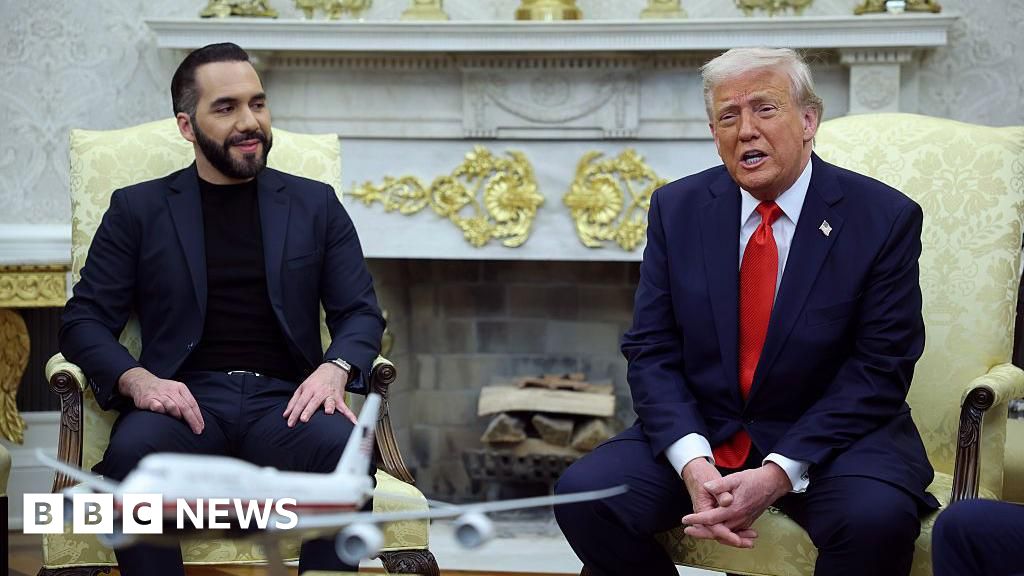
Donald Trump will host Latin American and Caribbean leaders on Saturday at his golf club for the "Shield of the Americas Summit" — an event aimed at rallying allies around US national security interests and countering China's growing influence in the region.
While the US spent much of the last decade focused elsewhere, China is now the region's top lender and trading partner, financing major projects like the $3.5bn (£2.6bn) Chancay megaport in Peru and the Bogotá metro in Colombia, among others.
Now, the American government wants to reclaim lost ground. But experts warn that establishing meaningful relationships will take more than military posturing, tariffs, and strong-arming.
Leading the diplomatic effort is Kristi Noem — dismissed by Trump this week as Secretary of Homeland Security — who has been tapped as special envoy for the summit. "In this new role, I will be able to build on the partnerships and national security expertise," Noem wrote on X following her firing.
She will be joined by conservative leaders from eight nations — Argentina, Paraguay, El Salvador, Chile, Panama, Honduras, Guyana, and Ecuador — who share ideological ties with the Trump administration. Colombia, Mexico, and Brazil will be absent.
Evan Ellis, professor of Latin American studies at the US Army War College Strategic Studies Institute, expects the summit to focus on drug trafficking, migration, counter-terrorism, and curbing Beijing's hemispheric influence.
"I'm kind of anticipating a Latin American CPAC," says adds Ellis, referencing the annual Conservative Political Action Conference, which draws right-leaning politicos from across the US.
The Trump administration has said Saturday's summit aims to "enlist and expand" US friends in the Western Hemisphere and limit Chinese engagement across the Americas, including moving to prevent rivals from establishing military or strategic footholds in the region. The meeting follows Trump's recent focus on the Caribbean, and his earlier statements about how the US should "take back" the Panama Canal from China.
His pressure in the region has already led to major changes - from the ousting of Venezuela's President Nicolas Maduro to Panama's Supreme Court's decision, earlier this year, to cancel a Hong Kong-company's contracts in the canal.
But the American government faces significant challenges, says Enrique Dussel Peters, professor of economics and coordinator of the Center for Chinese-Mexican Studies at the National Autonomous University of Mexico (UNAM).
"Gone are the days of development partnerships, free trade, multilateralism, and even basic reciprocity," Dussel said. China's presence in Latin America and the Caribbean has grown "drastically," he told the BBC, while the US response remains "late and reactive".
Dussel says policies such as "America First," foreign-aid cuts, and tariffs have backfired, pushing regional governments closer to a China that has spent decades building a long-term strategic vision for Latin America.
The numbers bear that out: From 2014 to 2023, China directed roughly $153bn in financial assistance to the region — nearly three times the $50.7bn the US contributed over the same period, per research lab AidData.
By 2024, Beijing had formalised free trade agreements with Chile, Costa Rica, Ecuador, Nicaragua, and Peru and these trade partnerships have been lucrative. In 2000, the Chinese market accounted for less than 2% of Latin America's exports. The Council on Foreign Affairs reports that by 2021, trade exceeded $450bn. Some economists expect that number to breach $700bn by 2035.
China has also poured money into developing Latin America's infrastructure, with 20 nations across the region joining the Belt and Road Initiative, a massive global infrastructure and investment project launched by Xi Jinping in 2013. Originally designed to connect East Asia and Europe, it has since expanded to Africa, Oceania, and Latin America, growing China's economic and political reach worldwide.
Since 2005, the China Development Bank and the Export-Import Bank of China have loaned more than $120bn to countries in Latin America and the Caribbean. These state-owned banks have become the leading lenders behind nearly 138 infrastructure projects, including the Belo Monte transmission grid in Brazil, the Kirchner-Cepernic hydroelectric dams in Argentina, and the Espacio Lejano space station in Neuquén, Argentina.
These projects aren't charity – China has its own economic motivations.
Beijing is channeling substantial investment into the so-called "lithium triangle" — the mineral-rich belt across Argentina, Bolivia, and Chile that holds 56% of the world's lithium reserves. In May 2025, President Xi Jinping announced a 9bn yuan credit line for the region.
And while Beijing's loans are often perceived as coming with fewer strings attached than those from the US, critics in the region have warned that economically vulnerable nations, such as Venezuela, risk falling into "debt traps" that can quickly spiral toward default. Caracas, which owes China $60bn, had been repaying the debt with reduced-price oil until Maduro was detained by Trump.
Detractors also point to lower environmental and labor standards among Chinese firms operating in the region. Many have raised alarms over the national security implications of China's expanding control over critical infrastructure, including ports and energy grids.
In response, China has tried to shift towards smaller, local projects facilitating tech exports and building next-generation infrastructure: 5G networks, power transmission, high-speed rail, electric vehicles, data centers, and artificial intelligence.
"These sorts of large, flashy projects, still discussed here and there — that's not the story anymore," says Margaret Myers, Managing Director of the Institute for America, China, and the Future of Global Affairs (ACF) at Johns Hopkins University.
Myers adds that these newer investments allow China to fly "under the radar at moments when its engagement is being critiqued more seriously".
For professor Evan Ellis, resisting these advances "requires US companies willing to invest in the region at large scale as an alternative to China". The US needs to offer "products and technologies that can compete on cost and features".
Many governments across Latin America are trying to maintain a balancing act, avoiding overdependence on any single partner.
Facundo Robles, professor at the National Defense University of Argentina, notes that Brazil, for example, maintains deep trade ties with China while preserving strategic cooperation with the US and Europe. "Argentina, beyond the rhetoric and due to its federalism, attempts something similar," he says.
Amid this rivalry for regional influence, Donald Trump is scheduled to travel to China to meet with President Xi Jinping on 31 March. According to Robles, the best outcome for the region would be to diversify economic partners and attract broader investment — while the worst would be a toxic great-power competition that ultimately narrows the options available to smaller countries.
 Meridiano