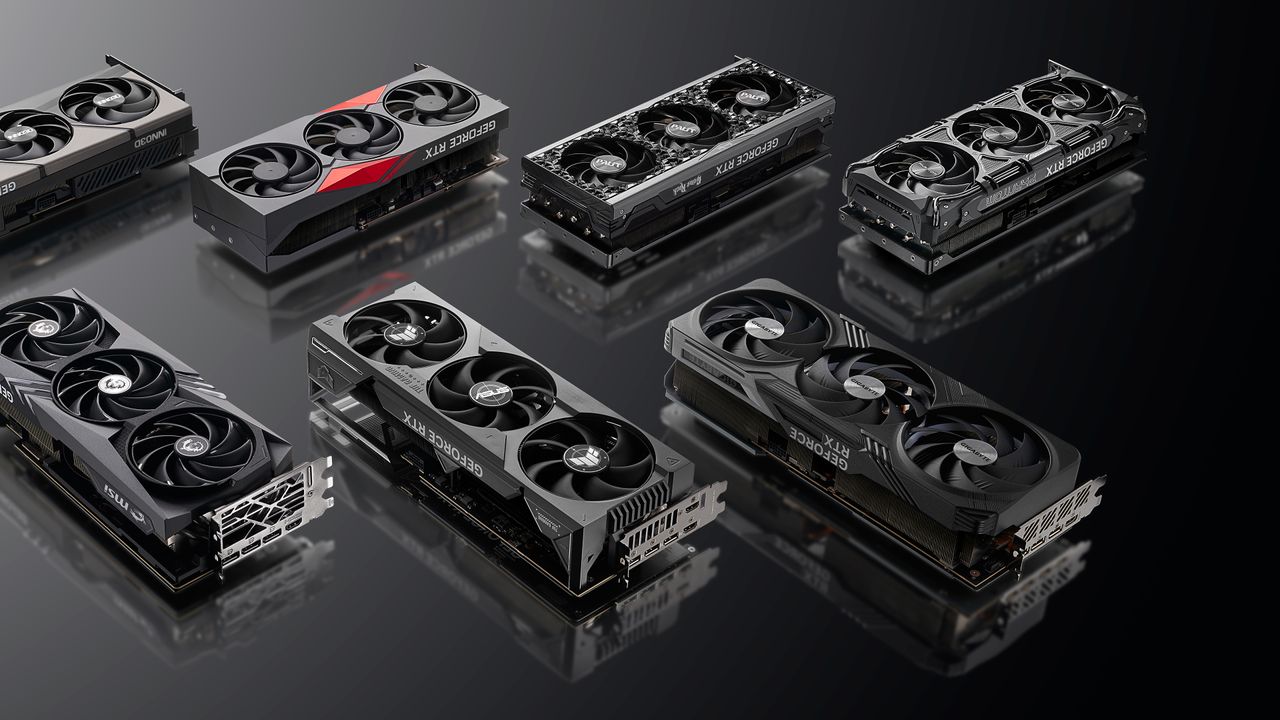
The discrete desktop graphics card market saw significant growth in 2025, with shipments reaching 44.28 million units, largely driven by Nvidia's new GeForce RTX 50-series. However, Nvidia achieved overwhelming market dominance, ending the year with a 94% share, while AMD's share plummeted to a historical low of 5%.
The report attributes AMD's decline to the unsuccessful launch of its Radeon RX 9000-series and notes that Intel's new Arc Battlemage cards failed to gain market share. It also cites factors like competition from notebooks, high component prices, and geopolitical tariffs as pressures on the add-in-board market.
Looking ahead, analysts predict the desktop graphics card market will decline by approximately 10% in 2026 due to continued supply constraints, high memory costs, and general economic uncertainty causing consumers to delay upgrades.
Main Topics: Discrete GPU market share and shipments; Nvidia's dominance and AMD's decline; market pressures and future outlook.
Nvidia dominates gaming GPU market with 95 percent share as sales of AMD Radeon graphics plummet to a historical low of 5 percent
As the market of graphics cards rises year-over-year.
Get Tom's Hardware's best news and in-depth reviews, straight to your inbox.
You are now subscribed
Your newsletter sign-up was successful
Shipments of discrete graphics cards for desktop PCs last year were the second highest in this decade and increased by nearly 10 million units to around 44.28 million in 2025 compared to 2024, according to Jon Peddie Research. However, the vast majority of graphics boards sold last year carried a GeForce GPU from Nvidia, whereas sales of AMD Radeon-badged cards hit an all-time low, based on data from JPR.
The industry shipped 44.28 million graphics cards in calendar 2025, up from 34.7 million units in 2024, mainly because Nvidia released its GeForce RTX 50-series graphics processors based on the Blackwell architecture. Sales of standalone graphics cards for desktops peaked in Q3, when the industry supplied 12 million units, and were slightly down sequentially in Q4, when makers of add-in-boards (AIBs) shipped 11.48 million units, which was still up from 8.4 million units year-over-year. Traditionally, graphics card sales for desktops peak in Q4 as gamers prep for the release of new games. However, this was not the case in 2025 due to a variety of reasons.
"The AIB market, largely supported by gamers, is being squeezed from the bottom by powerful new notebooks and CPU integrated graphics, and from the high end by rising pricing due to competition (supply and demand), memory prices, and Trump administration tariffs that bounce around," explained Dr. Jon Peddie, president of Jon Peddie Research.
When it comes to market share, Nvidia dominated the market throughout the whole of 2025 as it entered the year with a 92% share in Q1 and exited the year with a 94% share in Q4 (gaining 1.6% in the fourth quarter alone). By contrast, AMD shipped 8% of graphics cards in the first quarter of 2025 as it was getting ready to launch its Radeon RX 9000-series GPUs and exited the year with a 5% share in Q4 as these products failed to garner popularity among the target audience, perhaps due to scarce availability at recommended prices early in the lifecycle.
A 5% share of the desktop AIB market is the lowest share that AMD or ATI Technologies has ever had. The company can, of course, boast of a significant share of the integrated GPU market, as nearly all Ryzen processors for desktops carry an iGPU, but this is an entirely different market that is far less loyal or lucrative than the market for standalone graphics cards for desktops.
As Nvidia was gaining market share throughout 2025, while AMD was losing it, the company's unit shipments also dropped from 0.74 million in the first quarter to 0.57 million units in the fourth quarter. Again, selling 570,000 graphics cards in a quarter is the lowest result for both AMD and its predecessor, ATI.
When it comes to Intel, although the company released some new Arc graphics cards based on the Battlemage architecture, they were mostly targeted at select niches, which is why Intel has not gained any market share in 2025.
Get Tom's Hardware's best news and in-depth reviews, straight to your inbox.
Due to constrained supply of GPUs, high GDDR memory prices, and geopolitical uncertainties, the market of graphics cards for desktops will decline by 10% year-over-year, according to Jon Peddie Research.
"Customers who would, and in some cases should, be replacing their PCs and AIB are holding off," Peddie added. "We think because of these unstable conditions, the PC and AIB market will decline almost 10% in 2026."
Follow Tom's Hardware on Google News, or add us as a preferred source, to get our latest news, analysis, & reviews in your feeds.
Anton Shilov is a contributing writer at Tom’s Hardware. Over the past couple of decades, he has covered everything from CPUs and GPUs to supercomputers and from modern process technologies and latest fab tools to high-tech industry trends.
 Meridiano