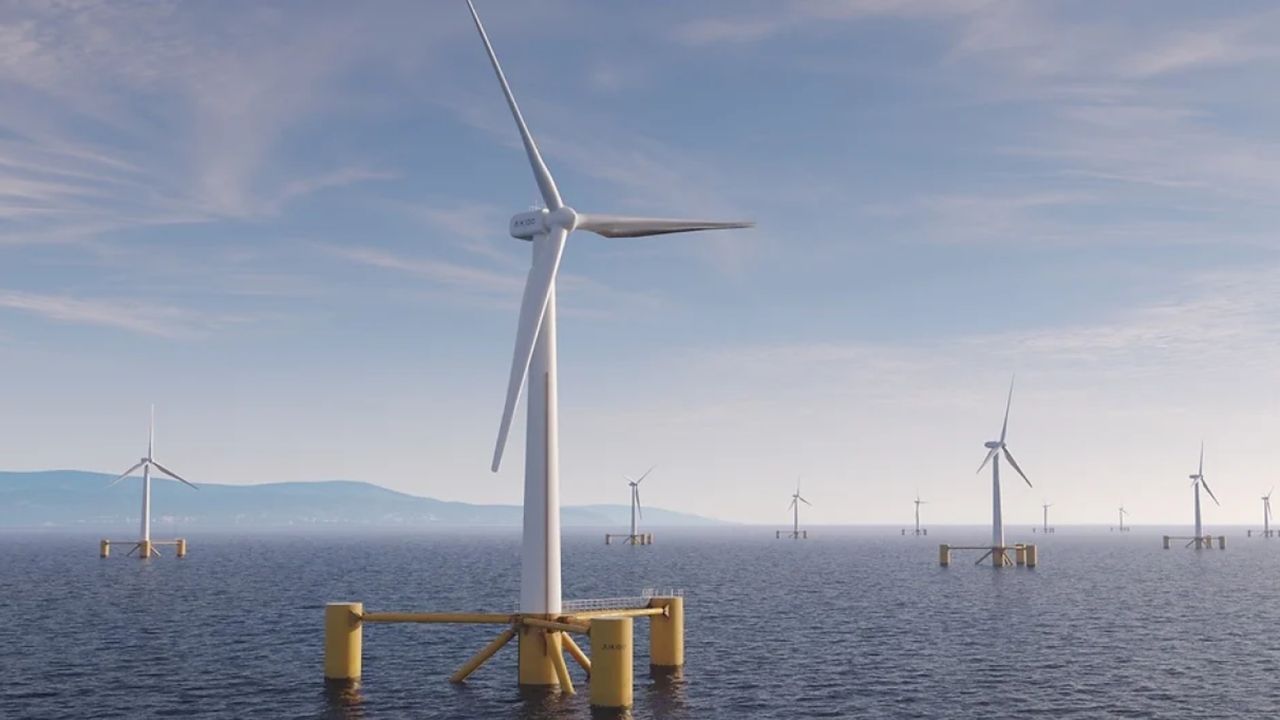
A San Francisco startup, Aikido Technologies, plans to build a prototype offshore wind turbine in the North Sea by 2026 that integrates water-cooled AI data centers within its three supporting legs. The design aims to address AI's growing power and space demands by co-locating compute infrastructure with its renewable energy source and using cold seawater for efficient cooling.
The system would use fresh water ballast in the turbine legs for both stability and as a cooling medium for the servers, with the North Sea chilling the warmed water. While offering potential cost benefits, the concept faces challenges including inconsistent wind power, requiring battery backups and grid connections, and the harsh, corrosive marine environment.
This offshore approach is presented as a potential solution to land-based data center constraints, with similar concepts being explored in other countries like China.
The main topics covered are an innovative offshore wind turbine design, integrated data centers for AI compute, a water-cooling solution, and the associated challenges and potential of the concept.
US startup plans to build data centers inside ocean-based wind turbines, servers water cooled via chilly North Sea — each leg houses a data center, firm set to launch three-legged prototype in Norway’s North Sea this year
Will this solve AI's power problems?
Get Tom's Hardware's best news and in-depth reviews, straight to your inbox.
You are now subscribed
Your newsletter sign-up was successful
San Francisco-based startup Aikido Technologies, which is focused on building offshore wind turbines, is experimenting with adding data centers to its power platforms. According to IEEE Spectrum, the company plans to launch a 100-kilowatt unit that combines a wind turbine with an AI server off the coast of Norway in the North Sea by the end of 2026. This move will address the power and space challenges many AI hyperscalers are facing right now, especially as many projects get mired in “not in my backyard” fights.
Aikido is using a semi-submersible design for its offshore wind turbines, similar to what many oil and gas companies use when drilling in high seas. This design comes with three ballast-filled legs, filled with fresh water to help maintain buoyancy and stay upright. From there, it’s secured to the seabed via chains and anchors, ensuring that it will remain in the general area, even as the wind and ocean batter it.
The firm says that it can add up to a 3- to 4-MW data hall in the upper part of each leg, meaning each wind turbine can potentially become a 9- to 12-MW data center. The fresh-water ballast is still stored in the lower part of each leg, which is then pumped towards the AI chips for cooling. The warm water is then pumped back into the ballast, with the chilly waters of the North Sea cooling it down. It also added an air-conditioner to manage the temperature of other components that aren’t part of the water-cooling loop.
“We have this power from the wind. We have free cooling. We think we can be quite cost competitive compared to conventional data-center solutions,” Aikido CEO Sam Kanner told IEEE Spectrum. “This crunch in the next five years is an opportunity for us to prove this out and supply AI compute where it’s needed.”
However, building a wind-powered offshore data center is not without its challenges. First off, wind power isn’t exactly consistent throughout the year, so each 'data center' will have batteries for storing excess energy and delivering it in times of low production. If the lean season extends far longer than anticipated, it’s also connected to the grid, allowing it to use power from other sources. Aside from this, the sea can be quite unforgiving, and salt water is particularly corrosive, possibly leading to higher maintenance costs.
Nevertheless, experiments like this can potentially solve the power and space problems that most land-based data centers face at the moment. In fact, China has thought of a similar approach, with a wind-powered underwater data center prototype launched in Shanghai in October last year. Although this might seem like an ambitious project, it’s still far more feasible than Elon Musk’s plan of launching a million data center satellites orbiting around the earth.
Follow Tom's Hardware on Google News, or add us as a preferred source, to get our latest news, analysis, & reviews in your feeds.
Get Tom's Hardware's best news and in-depth reviews, straight to your inbox.
Jowi Morales is a tech enthusiast with years of experience working in the industry. He’s been writing with several tech publications since 2021, where he’s been interested in tech hardware and consumer electronics.
 Meridiano