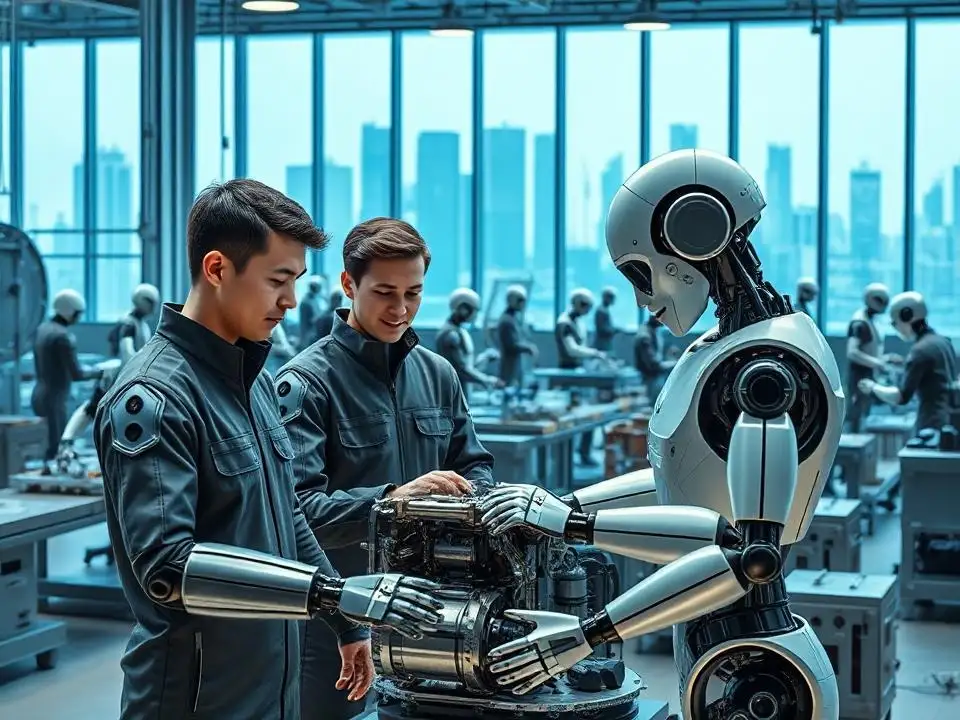
ABB and Nvidia have partnered to improve industrial robot performance by using Nvidia's Omniverse platform to create more realistic virtual training simulations. These simulations incorporate real-world details like lighting and vibrations, allowing robots to be pre-trained for complex tasks before physical deployment.
This technology aims to reduce costs and speed up production by minimizing the need for physical prototypes and on-site troubleshooting. It is scheduled for launch in late 2026 and is being piloted by companies like Foxconn for tasks in sectors such as automotive and consumer electronics.
The main topics covered are the ABB-Nvidia partnership, the use of advanced simulation for robot training, and the expected benefits of reduced costs and faster deployment.
ABB's robotics business has partnered with Nvidia to narrow the gap between how industrial robots perform in virtual simulations and how they behave on factory floors, the âcompanies said â on Monday.
Swiss-based â ABB will use Nvidia's Omniverse libraries of simulated data to make its training environments more realistic by incorporating details such as lighting, shadows, and textures.
ABB Robotics President Marc Segura said robots often have limited information about the world around them, which can undermine accuracy, repeatability and speed.
Segura cited the example of a factory ârobot working close to a stamping machine, which â created massive âvibrations which reduced the robot's performance.
Over time the robot could âlearn or âbe programmed how to deal with the vibration, but â the technology meant it will already be trained virtually and "know âfrom day one," Segura told Reuters. "This will save âcompanies a lot of time and money."
The development is part of a growing trend where companies run more of their production planning and robot setup in digital simulations to spot problems before equipment starts operating.
ABB said the system, delivered via its robot control software, could cut âcosts and speed time to market by reducing the need for physical prototypes of products and assembly lines.
The technology, due âfor launch âin the second â half of 2026, is expected to serve customers in sectors including automotive and consumer electronics.
Electronics contract manufacturer Foxconn is already piloting the technology to install side buttons âinto consumer electronics, a task ABB said was previously difficult because shadows hindered robot vision.
"The industrial sector needs physically accurate simulation to bridge the gap between virtual training and the real-world deployment of AI-driven robotics at scale," said Deepu Talla, vice president of robotics and edge AI at Nvidia.
Swiss-based â ABB will use Nvidia's Omniverse libraries of simulated data to make its training environments more realistic by incorporating details such as lighting, shadows, and textures.
ABB Robotics President Marc Segura said robots often have limited information about the world around them, which can undermine accuracy, repeatability and speed.
Segura cited the example of a factory ârobot working close to a stamping machine, which â created massive âvibrations which reduced the robot's performance.
Over time the robot could âlearn or âbe programmed how to deal with the vibration, but â the technology meant it will already be trained virtually and "know âfrom day one," Segura told Reuters. "This will save âcompanies a lot of time and money."
The development is part of a growing trend where companies run more of their production planning and robot setup in digital simulations to spot problems before equipment starts operating.
ABB said the system, delivered via its robot control software, could cut âcosts and speed time to market by reducing the need for physical prototypes of products and assembly lines.
The technology, due âfor launch âin the second â half of 2026, is expected to serve customers in sectors including automotive and consumer electronics.
Electronics contract manufacturer Foxconn is already piloting the technology to install side buttons âinto consumer electronics, a task ABB said was previously difficult because shadows hindered robot vision.
"The industrial sector needs physically accurate simulation to bridge the gap between virtual training and the real-world deployment of AI-driven robotics at scale," said Deepu Talla, vice president of robotics and edge AI at Nvidia.
 Meridiano