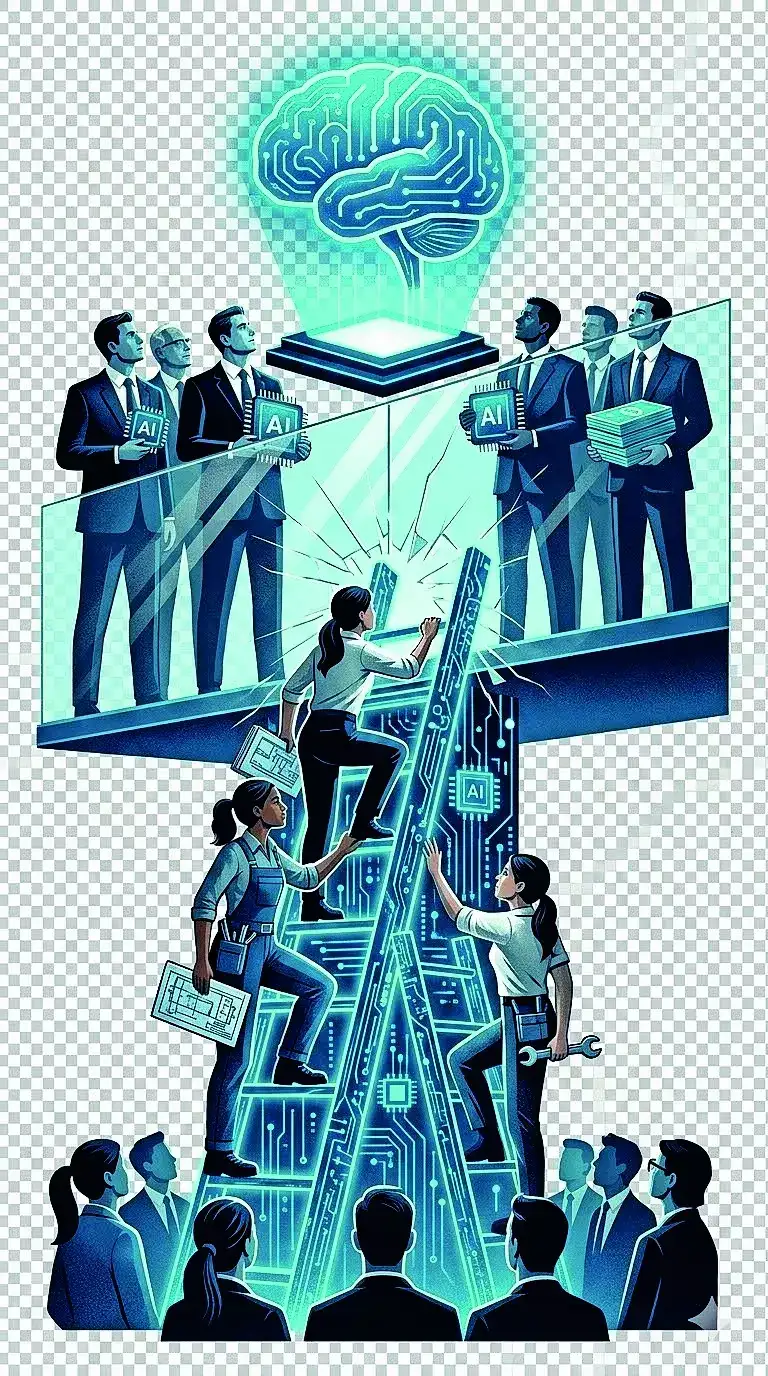
While a notable list of Indian women leading AI startups exists, they represent a small minority. Only about 10% of AI startups in India are founded by women, and women constitute only about one-fifth of the country's AI workforce.
This underrepresentation is part of a broader "leaky pipeline" in tech careers, where women's participation declines at higher levels and in specialized AI disciplines like model development and research. Despite strong representation in STEM education, women are often concentrated in applied AI roles rather than core technical or leadership positions.
Furthermore, women in India face a disproportionate risk from AI-driven job disruption, with about 80% of women working in roles vulnerable to automation. Experts link the gender gap in AI to wider social and economic inequalities.
Main Topics: Underrepresentation of women in Indian AI entrepreneurship and leadership; the "leaky pipeline" in tech careers; gender disparity in specialized AI roles; and the disproportionate impact of AI automation on women's jobs.
A simple search for Indian women leading the AI charge throws up the following CEOs, founders: Ashwini Asokan (Mad Street Den), Geetha Manjunath (NIRAMAI Health Analytix), Prukalpa Sankar (Atlan), Bindu Reddy (Abacus.ai), Pranjali Awasthi (Delv.AI), Ritwika Chowdhury (Unscript.AI), Laina Emmanuel and Rimjhim Agrawal (BrainSight.AI), Meghna Saraogi (MirrAR), Hardika Shah (Kinara Capital), and MD Nidhi (NEMA AI) and Irina Ghose (MD, India, Anthropic).
They belong to a small minority. Only about 10% of AI startups in India are founded by women. None of the 12 core organisations and consortia recently shortlisted by the IndiaAI Mission to develop indigenous foundational models has listed women as primary founders. Among the 24 most-funded AI startups in India, none have an all-women founding team, a Wired for Impact: Women in Ind(AI) by Kalaari Capital and the CXXO report says.
âI donât think this is only an AI problem. It is a bigger social and economic problem. If women are under-represented across the economy, they will also be under-represented in frontier sectors like AI,â Abhilasha Singh, cofounder, Heizen, an AI-powered software services startup.
To be sure, the gender ratio in new age entrepreneurship is heavily skewed towards men. A 2023 report (LEAD, Krea University) on Indiaâs startup ecosystem found that 18% of founders/CEOs and 21% of senior leaders in startups were women. In AI, it is even starker at 10%.
Leaky pipeline of tech careers
Womenâs lower participation in AI is not limited to the founder level; it progressively declines along the organisational ladder in what experts describe as a âleaky pipelineâ in technology careers.
Women account for only about one-fifth of Indiaâs fast-growing AI workforce, or around 84,000 professionals, according to multiple industry reports and discussions at the IndiaAI Impact Summit 2026.
Experts expect a positive shift with a four-fold increase in this number in the short term. âAI is transforming industries and redefining the future of work, yet women remain underrepresented, particularly in leadership and entrepreneurship,â said Neelima Vobugari, cofounder of AI testing startup AiEnsured.
This is despite their higher participation in STEM education, she noted. India produces large pools of science and technology graduates, with women making up around 43% of STEM graduates. But representation narrows dramatically in specialised AI disciplines. Women constitute only 29-30% of students in generative AI programmes.
âWomen are well represented across Indiaâs technology workforce, but their presence narrows in specialised AI and leadership roles,â said Nitin Mahajan, chief executive of 1Point1 Solutions. âEarlier generations saw fewer women specialising in deep-tech fields such as machine learning and advanced data science, which has affected representation in senior roles today.â
The types of roles women occupy further complicate the picture. Women are more likely to work in data analytics, data engineering, AI operations and applied AI roles, while remaining underrepresented in core technical fields such as AI model development, research, architecture and product design. These core roles as stepping stones to senior technical positions and executive leadership. Research output reflects similar patterns.
Across South Asia, 71.76% of AI research publications include at least one female author, but only 26.01% have women as primary or corresponding authors. Analysis of LinkedIn profiles showed that 29.92% of AI engineering talent in India in 2024 were women.
Women at greater risk
Another pressing concern emerges as AI adoption accelerates. A LinkedIn-UN Women analysis found that generative AI could substitute up to a quarter of existing jobs. In India specifically, about 80% of women work in jobs that could be augmented or disrupted by AI, compared with 75% of men.
Researchers say women are often concentrated in occupations more vulnerable to automation.
Kirthiga Reddy, cofounder of OptimizeGEO.ai and founder of AI Kiran, emphasised that with women holding only 18% of leadership roles in technology, the challenge lies not in capability but in opportunity and awareness.
"The biggest misconception holding women back is the belief that AI careers require hardcore programming skills," she said.
"The field actually needs many different skills and disciplines, from product thinking and design to policy, domain expertise and entrepreneurship. Encouraging girls to see AI as problem-solving and innovation â rather than just programming â is key to improving representation. The perception that AI equals coding that in turn equals male discourages girls from exploring AI even before they understand the field."
With inputs from Himanshi Lohchab
They belong to a small minority. Only about 10% of AI startups in India are founded by women. None of the 12 core organisations and consortia recently shortlisted by the IndiaAI Mission to develop indigenous foundational models has listed women as primary founders. Among the 24 most-funded AI startups in India, none have an all-women founding team, a Wired for Impact: Women in Ind(AI) by Kalaari Capital and the CXXO report says.
âI donât think this is only an AI problem. It is a bigger social and economic problem. If women are under-represented across the economy, they will also be under-represented in frontier sectors like AI,â Abhilasha Singh, cofounder, Heizen, an AI-powered software services startup.
To be sure, the gender ratio in new age entrepreneurship is heavily skewed towards men. A 2023 report (LEAD, Krea University) on Indiaâs startup ecosystem found that 18% of founders/CEOs and 21% of senior leaders in startups were women. In AI, it is even starker at 10%.
Leaky pipeline of tech careers
Womenâs lower participation in AI is not limited to the founder level; it progressively declines along the organisational ladder in what experts describe as a âleaky pipelineâ in technology careers.
Women account for only about one-fifth of Indiaâs fast-growing AI workforce, or around 84,000 professionals, according to multiple industry reports and discussions at the IndiaAI Impact Summit 2026.
Experts expect a positive shift with a four-fold increase in this number in the short term. âAI is transforming industries and redefining the future of work, yet women remain underrepresented, particularly in leadership and entrepreneurship,â said Neelima Vobugari, cofounder of AI testing startup AiEnsured.
This is despite their higher participation in STEM education, she noted. India produces large pools of science and technology graduates, with women making up around 43% of STEM graduates. But representation narrows dramatically in specialised AI disciplines. Women constitute only 29-30% of students in generative AI programmes.
âWomen are well represented across Indiaâs technology workforce, but their presence narrows in specialised AI and leadership roles,â said Nitin Mahajan, chief executive of 1Point1 Solutions. âEarlier generations saw fewer women specialising in deep-tech fields such as machine learning and advanced data science, which has affected representation in senior roles today.â
The types of roles women occupy further complicate the picture. Women are more likely to work in data analytics, data engineering, AI operations and applied AI roles, while remaining underrepresented in core technical fields such as AI model development, research, architecture and product design. These core roles as stepping stones to senior technical positions and executive leadership. Research output reflects similar patterns.
Across South Asia, 71.76% of AI research publications include at least one female author, but only 26.01% have women as primary or corresponding authors. Analysis of LinkedIn profiles showed that 29.92% of AI engineering talent in India in 2024 were women.
Women at greater risk
Another pressing concern emerges as AI adoption accelerates. A LinkedIn-UN Women analysis found that generative AI could substitute up to a quarter of existing jobs. In India specifically, about 80% of women work in jobs that could be augmented or disrupted by AI, compared with 75% of men.
Researchers say women are often concentrated in occupations more vulnerable to automation.
Kirthiga Reddy, cofounder of OptimizeGEO.ai and founder of AI Kiran, emphasised that with women holding only 18% of leadership roles in technology, the challenge lies not in capability but in opportunity and awareness.
"The biggest misconception holding women back is the belief that AI careers require hardcore programming skills," she said.
"The field actually needs many different skills and disciplines, from product thinking and design to policy, domain expertise and entrepreneurship. Encouraging girls to see AI as problem-solving and innovation â rather than just programming â is key to improving representation. The perception that AI equals coding that in turn equals male discourages girls from exploring AI even before they understand the field."
With inputs from Himanshi Lohchab
 Meridiano