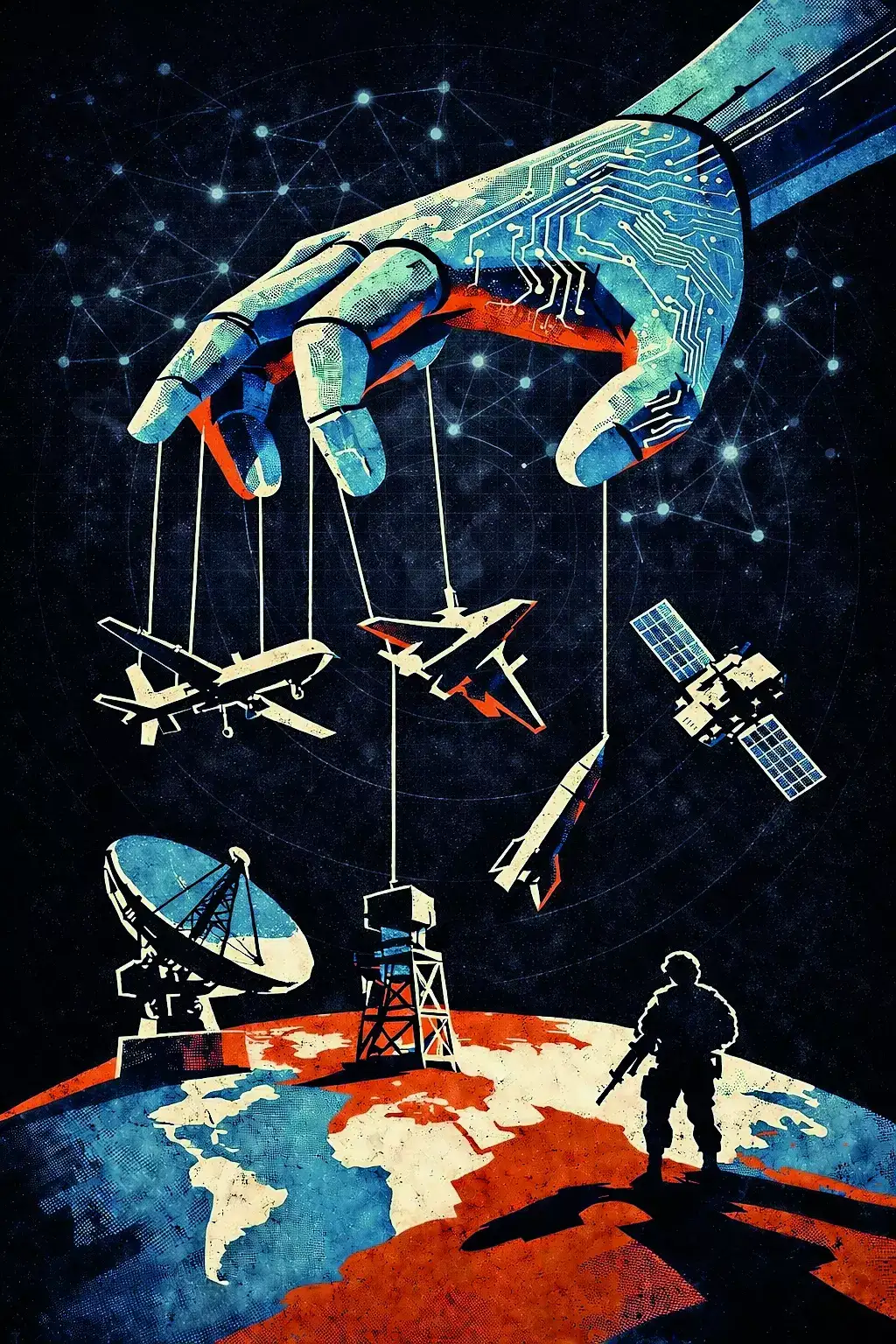
The recent standoff between the Trump administration and AI company Anthropic highlights growing concerns over AI's role in mass surveillance and military applications, framing AI development as a critical national security issue. For nations like India, which rely heavily on imported AI technology and defense hardware, this underscores a strategic vulnerability and the urgent need to develop sovereign AI capabilities.
The article details the increasing use of AI, including Anthropic's Claude model, in geopolitical conflicts for tasks like intelligence processing and target tracking, raising serious ethical questions about accountability and misuse. However, experts caution that achieving full AI sovereignty is extremely difficult, as it requires local control over the entire supply chain, from chips to data.
The main topics covered are: the national security imperative of AI sovereignty, the geopolitical use and risks of AI in warfare and surveillance, and the practical challenges nations face in achieving technological independence.
The Donald Trump administrationâs last weekâs tug-of-war with artificial intelligence giant Anthropic has raised several questions about how the emerging technology can be used for mass surveillance not just of US citizens but also globally.
As AI becomes increasingly embedded in defence strategy, experts say that AI sovereignty is no longer a question of data advantage or regional appropriateness but a question of ânational securityâ that every nation, especially India should put as its top priority!
The debate carries particular urgency for India. The country not only imports critical defence hardware â missiles, fighter aircraft and radar systems â from allies like the US, Russia and France, but also remains heavily dependent on foreign large language models (LLMs) and AI chips on countries like the US and China.
Meanwhile, China has already established itself as an AI superpower declaring its independence in all spheres of AI.
âNation states with the lead in AI technology will accelerate its use for geopolitical advantageâ¦export of technology is no longer an economic but a geopolitical advantage,â said Lieutenant General Deependra Singh Hooda, former Commander-in-Chief of the Indian army's Northern Command who led Indiaâs Surgical Strike in 2016.
He explained that both US and China have built self-sufficiency across the AI stack which is worrisome from an ethical standpoint.
âIf governments can predict an adversaryâs move or preempt a major crisis, they can shield themselves in new ways,â said Abishur Prakash, an author and geopolitical strategist at Canada-based advisory firm The Geopolitical Business Inc.
However, the rapid adoption of generative AI also raises concerns about accountability and misuse.
âWhat happens when nefarious actors have access to advanced GenAI? And, second, as governments depend on GenAI for geopolitics (e.g., identifying targets in a conflict zone), who does blame fall on when something goes wrong?,â he asked.
The AI advantage
AI has been an active battlefield participant in the Gaza War, Russia-Ukraine conflict as well as the latest Iran/Middle East turbulence.
The Israeli forces used âWhereâs Daddy?â a tracking tool which mapped targeted Hamas individuals movement for days during Gaza attacks.
Anthropicâs Claude model was used by the US military in Operation Roaring Lion which killed Iranâs Supreme Leader Ayatollah Ali Khamenei and 48 others.
Claude was also reportedly used in partnership with Palantir Technologies to process intelligence and simulate raid scenarios before Venezuelaâs President Nicolás Maduro was captured by the US military in January this year. Palantir and Anthropic had signed several multi-million dollar deals with the Pentagon along with several other AI firms over the last two years.
Things came to a head when Anthropic declined to remove safeguards on Claude, triggering the government to terminate all use of Anthropic products, including the Claude platform and included a stern warning from president Trump to âcomplyâ.
Anthropic chief Dario Amodei said on Thursday that the US government declared his company âa supply chain riskâ and said it has âno choiceâ but to challenge the designation in court.
OpenAI, which moved fast to sign a contract with the Pentagon to supply AI models for classified settings. The company, however, faced a lot of external and internal criticism and later said that it would modify its Pentagon contract to ensure its AI models are not used for domestic surveillance.
Need for sovereign AI
While sovereign AI sounds great on paper, it's impossible to achieve unless a nation sources chips, data servers, software, and builds LLMs on locally-controlled data, experts said.
Pranay Kotasthane, deputy director of the Takshashila Institution, author and researcher in semiconductor, geopolitics and policy, said that no country can be fully sovereign across the AI supply chain.
âThe AI that matters most in warfare right now is not LLMs, itâs computer vision and autonomous systems. Open-weight LLM models are available to all countries even today. They donât offer any strategic advantage,â he said.
Instead, the real advantage lies in how AI is integrated into military networks. Modern warfare increasingly relies on C4ISR systems â command, control, communications, computers, intelligence, surveillance and reconnaissance â where AI can process large volumes of data and accelerate decision-making.
âThe real military AI advantage comes from integration into kill chains and C4ISR systems, which is an engineering and doctrine problem,â Kotasthane said. In fact, India has the opportunity to close the gap in AI much faster than in jet engine manufacturing, he added.
âIndia's major worry would be that cheap autonomous weapon systems can upgrade the destructive potential of terrorists and smaller adversaries,â Kotasthane said.
Lt Gen Hooda also noted the need for more investments in defense R&D. India is among the top five military spenders globally, with the allocated defense budget of Rs 7.85 lakh crore (approximately $93.5 billion) in FY26-27, up 15.19% on-year. Of this, only Rs 29,100 crore is allocated to R&D.
For instance, China's Military-Civil Fusion (MCF) is a national-level strategy aimed at merging its defense industrial sector with its civilian technology and academic sectors to create the world's most advanced military by 2049. Overseen by President Xi Jinping, it focuses on acquiring, developing, and applying dual-use technologies such as AI, quantum computing, and aerospace.
The economics of war
AI is also reshaping the economics of war. Cheap drones and AI-powered targeting systems have already demonstrated their effectiveness in conflicts such as the war in Ukraine and Iran. For India, this shift presents both opportunity and risk.
Prakash noted that India faces competing pressures between defence suppliers such as the US, Russia and Europe, each pursuing their own strategic priorities.
âFor India, a decade ago, the goal may have been to have a massive military, equal to other large powers. But in light of how the current flashpoints are playing out, India may decide to take a different path, changing military procurement from the ground up,â he explained.
As AI becomes increasingly embedded in defence strategy, experts say that AI sovereignty is no longer a question of data advantage or regional appropriateness but a question of ânational securityâ that every nation, especially India should put as its top priority!
The debate carries particular urgency for India. The country not only imports critical defence hardware â missiles, fighter aircraft and radar systems â from allies like the US, Russia and France, but also remains heavily dependent on foreign large language models (LLMs) and AI chips on countries like the US and China.
Meanwhile, China has already established itself as an AI superpower declaring its independence in all spheres of AI.
âNation states with the lead in AI technology will accelerate its use for geopolitical advantageâ¦export of technology is no longer an economic but a geopolitical advantage,â said Lieutenant General Deependra Singh Hooda, former Commander-in-Chief of the Indian army's Northern Command who led Indiaâs Surgical Strike in 2016.
He explained that both US and China have built self-sufficiency across the AI stack which is worrisome from an ethical standpoint.
âIf governments can predict an adversaryâs move or preempt a major crisis, they can shield themselves in new ways,â said Abishur Prakash, an author and geopolitical strategist at Canada-based advisory firm The Geopolitical Business Inc.
However, the rapid adoption of generative AI also raises concerns about accountability and misuse.
âWhat happens when nefarious actors have access to advanced GenAI? And, second, as governments depend on GenAI for geopolitics (e.g., identifying targets in a conflict zone), who does blame fall on when something goes wrong?,â he asked.
The AI advantage
AI has been an active battlefield participant in the Gaza War, Russia-Ukraine conflict as well as the latest Iran/Middle East turbulence.
The Israeli forces used âWhereâs Daddy?â a tracking tool which mapped targeted Hamas individuals movement for days during Gaza attacks.
Anthropicâs Claude model was used by the US military in Operation Roaring Lion which killed Iranâs Supreme Leader Ayatollah Ali Khamenei and 48 others.
Claude was also reportedly used in partnership with Palantir Technologies to process intelligence and simulate raid scenarios before Venezuelaâs President Nicolás Maduro was captured by the US military in January this year. Palantir and Anthropic had signed several multi-million dollar deals with the Pentagon along with several other AI firms over the last two years.
Things came to a head when Anthropic declined to remove safeguards on Claude, triggering the government to terminate all use of Anthropic products, including the Claude platform and included a stern warning from president Trump to âcomplyâ.
Anthropic chief Dario Amodei said on Thursday that the US government declared his company âa supply chain riskâ and said it has âno choiceâ but to challenge the designation in court.
OpenAI, which moved fast to sign a contract with the Pentagon to supply AI models for classified settings. The company, however, faced a lot of external and internal criticism and later said that it would modify its Pentagon contract to ensure its AI models are not used for domestic surveillance.
Need for sovereign AI
While sovereign AI sounds great on paper, it's impossible to achieve unless a nation sources chips, data servers, software, and builds LLMs on locally-controlled data, experts said.
Pranay Kotasthane, deputy director of the Takshashila Institution, author and researcher in semiconductor, geopolitics and policy, said that no country can be fully sovereign across the AI supply chain.
âThe AI that matters most in warfare right now is not LLMs, itâs computer vision and autonomous systems. Open-weight LLM models are available to all countries even today. They donât offer any strategic advantage,â he said.
Instead, the real advantage lies in how AI is integrated into military networks. Modern warfare increasingly relies on C4ISR systems â command, control, communications, computers, intelligence, surveillance and reconnaissance â where AI can process large volumes of data and accelerate decision-making.
âThe real military AI advantage comes from integration into kill chains and C4ISR systems, which is an engineering and doctrine problem,â Kotasthane said. In fact, India has the opportunity to close the gap in AI much faster than in jet engine manufacturing, he added.
âIndia's major worry would be that cheap autonomous weapon systems can upgrade the destructive potential of terrorists and smaller adversaries,â Kotasthane said.
Lt Gen Hooda also noted the need for more investments in defense R&D. India is among the top five military spenders globally, with the allocated defense budget of Rs 7.85 lakh crore (approximately $93.5 billion) in FY26-27, up 15.19% on-year. Of this, only Rs 29,100 crore is allocated to R&D.
For instance, China's Military-Civil Fusion (MCF) is a national-level strategy aimed at merging its defense industrial sector with its civilian technology and academic sectors to create the world's most advanced military by 2049. Overseen by President Xi Jinping, it focuses on acquiring, developing, and applying dual-use technologies such as AI, quantum computing, and aerospace.
The economics of war
AI is also reshaping the economics of war. Cheap drones and AI-powered targeting systems have already demonstrated their effectiveness in conflicts such as the war in Ukraine and Iran. For India, this shift presents both opportunity and risk.
Prakash noted that India faces competing pressures between defence suppliers such as the US, Russia and Europe, each pursuing their own strategic priorities.
âFor India, a decade ago, the goal may have been to have a massive military, equal to other large powers. But in light of how the current flashpoints are playing out, India may decide to take a different path, changing military procurement from the ground up,â he explained.
 Meridiano