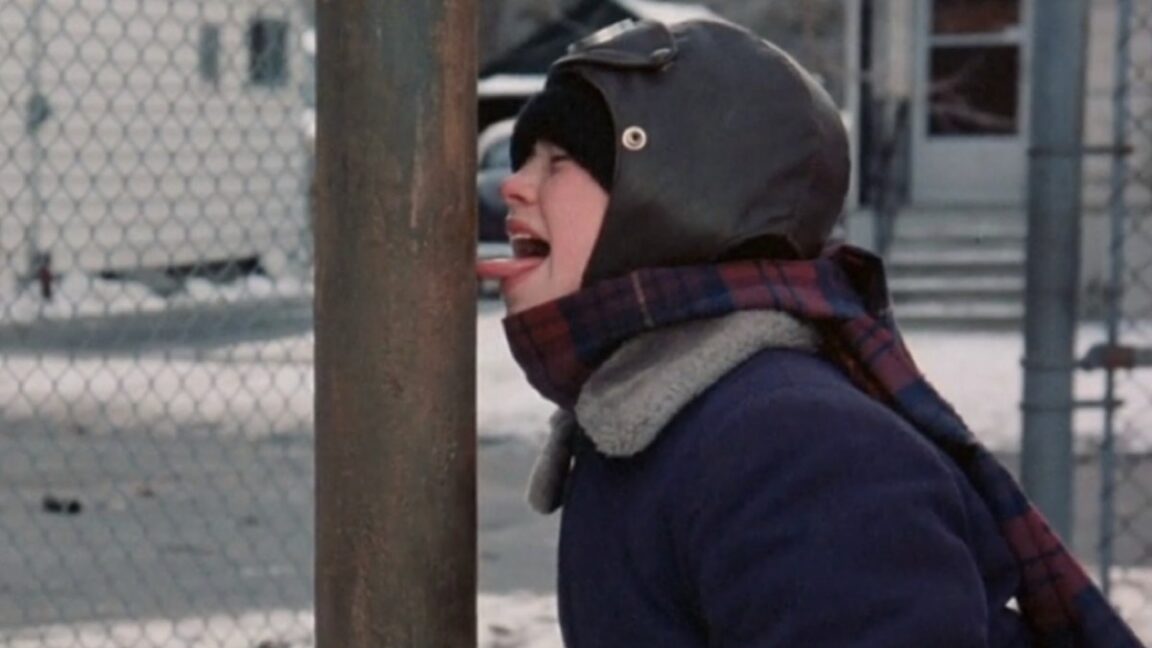
A graduate student investigated the science behind "tundra tongue," the phenomenon of a tongue sticking to cold metal, after experiencing it himself. His research team reviewed historical cases and published two scientific papers on the topic.
The study identified 113 unique cases in Scandinavia, with the earliest recorded incident dating back to 1845. That historical case resulted in injury when the person pulled their tongue free, highlighting the potential for damage.
The main topics covered are the scientific investigation of "tundra tongue," its historical prevalence and documented cases, and the potential risks and injuries associated with the phenomenon.
We all remember that infamous scene in the 1983 classic, A Christmas Story, where a young boy licks a cold metal post on the playground and ends up getting his tongue stuck to the surface. It’s practically a childhood rite of passage. A 1996 case study coined the term “tundra tongue” to describe the phenomenon. But how dangerous is it, really? And what’s the best way to free one’s tongue with minimal damage?
Anders Hagen Jarmund, a graduate student at the Norwegian University of Science and Technology (NTNU), experienced tundra tongue firsthand in his youth and had the same questions. So he decided to investigate the underlying science as part of his master’s thesis, recruiting several colleagues to the project. This turned into two separate papers: one published in the International Journal of Pediatric Otorhinolaryngology, and the other in the journal Head & Face Medicine.
“I’m from a small place called Hattfjelldal, which is quite cold in the winter,” Jarmund said of the rationale for undertaking the project. “I don’t remember if it was a signpost or a lamppost behind the school, but I remember licking it and my tongue got stuck. This was an experience that my friends had also had, actually, and then we were wondering if it was actually dangerous, getting your tongue stuck to a lamppost or railing.” (Their experience was common, it seems; Norway actually passed legislation in 1998 to prohibit any bare metal in playground equipment.)
The first step was to conduct a thorough review of historical newspaper accounts. Jarmund et al. identified 113 unique cases of tundra tongue in Norway, Sweden, and Denmark. The earliest case they found was in 1845, when a French schoolboy froze his tongue to a metal bridge; he lost some skin on the tongue and lips when he pulled away.
 Meridiano