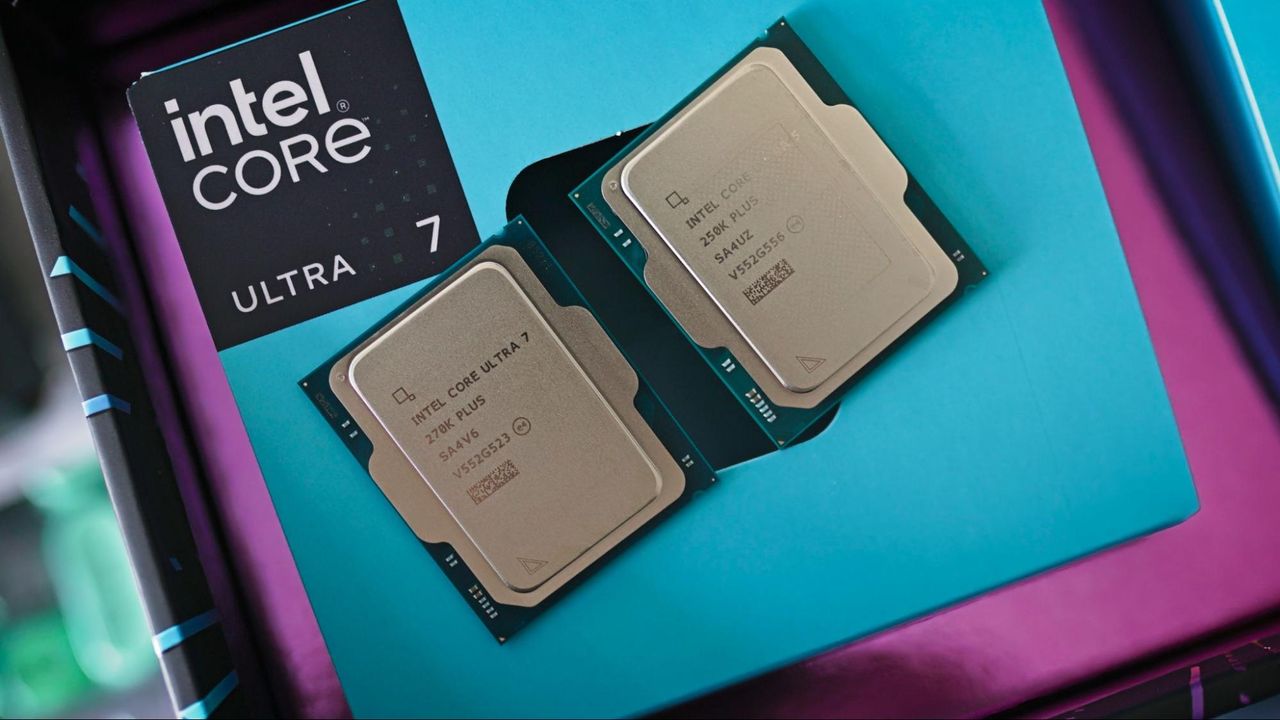
Intel has launched its Arrow Lake Refresh CPUs, branded as Core Ultra 200S Plus, headlined by the Core Ultra 7 270K and Core Ultra 5 250K. The company claims these new chips offer up to 15% higher gaming performance at 1080p compared to standard Arrow Lake models, achieved through increased core counts, a faster memory controller, and a new software tool called iBOT.
The refresh introduces four new SKUs, with the flagship models gaining four extra E-cores and a significant boost to the memory controller frequency to address previous latency issues. A key new feature is the Intel Binary Optimization Tool (iBOT), a binary translation layer designed to improve performance in select games, even those optimized for other architectures.
The main topics covered are the announcement and specifications of the new Arrow Lake Refresh CPUs, the claimed performance improvements for gaming, the architectural changes including the faster memory controller, and the introduction of the iBOT software optimization feature.
Intel claims Arrow Lake Refresh CPUs deliver 15% higher gaming performance and multi-threaded boost — Core Ultra 7 270K and Core Ultra 5 250K come with more cores, faster memory, and a price cut
Arrow Lake is suddenly looking a lot more attractive.
Get Tom's Hardware's best news and in-depth reviews, straight to your inbox.
You are now subscribed
Your newsletter sign-up was successful
Intel has finally revealed its long-awaited Arrow Lake Refresh CPUs. Dubbed Core Ultra 200S Plus, Intel is introducing two new chips in its lineup, both of which come with a price cut compared to their non-Plus predecessors. The headline claim is 15% higher gaming performance at 1080p compared to stock Arrow Lake chips — a number that Intel says it gathered from a geomean of 38 games tested at 1080p with High settings, in a bid to earn a spot among the best CPUs for gaming.
Arrow Lake Refresh brings four new SKUs total: two CPUs, each with two variations. Both come with an extra 4 E-cores compared to their stock designs, along with up to a 900MHz boost in die-to-die frequency, and they’ll be available in both K (unlocked) and KF (unlocked without integrated graphics) versions. The Core Ultra 7 270K Plus comes with 24 cores, split across eight P-cores and 16 E-cores, matching the Core Ultra 9 285K. The Core Ultra 5 250K Plus comes with 18 cores across six P-cores and 12 E-cores, falling slightly below the 20 cores available on the Core Ultra 7 265K.
~ = Unknown
Article continues belowIn addition to higher core counts, Intel boosted the speed of the memory controller by up to 900MHz. Memory (and core-to-core) latency was one of the weaker aspects of the Arrow Lake architecture initially, and Intel claims this boost will help drive “system latency down and gaming performance up.”
Arrow Lake is one of Intel’s most complex architectures to date, and the first to use a chiplet design (or tile-based design, as Intel calls it), brought together with Foveros packaging. The Compute Tile, built on TSMC N3B, lives apart from the SoC tile, built on N6, which houses the display and media engines, PCIe PHYs, memory PHYs, and the memory controllers. Previous Intel architectures have used a monolithic design where the memory controllers are very close to the cores. By boosting the clock of the memory controller, Intel hopes to drive down one of the weaker aspects of Arrow Lake from an architectural standpoint.
But that’s only one part of the gaming boost, according to Intel. The other side of it is the Intel Binary Optimization Tool, or iBOT, which Intel says is “a first-of-its-kind binary translation layer optimization capability that can improve native performance in select games.” This feature, according to Intel, can increase instruction per clock (IPC) in certain games, even if that game has been optimized for a different architecture or game console. Notably, Intel says it improves performance even for workloads optimized for other x86 architectures; this isn’t an ARM translation layer along the lines of Microsoft Prism or Apple Rosetta.
iBOT is one of the most interesting features of Arrow Lake Refresh, but we still don’t know much about it. Intel has kept its technical capabilities vague, so it’s something we’ll need to look into once we get our hands on the Core Ultra 7 270K and Core Ultra 5 250K. For now, Intel says iBOT is “a key aspect of Intel’s long-term performance roadmap for enthusiasts.” What we do know is that iBOT is an optional feature within Intel Application Optimization (APO) when you switch to advanced mode.
Get Tom's Hardware's best news and in-depth reviews, straight to your inbox.
Outside of the chips themselves, Intel is bringing faster memory speeds and early support for 4R CUDIMMs on select 800-series motherboards. For standard DDR5 DIMMs, Intel is upping the officially supported speeds to 7,200MT/s, which is a speed that even standard Arrow Lake chips can maintain, though it isn’t officially supported. With the Boost BIOS profile, warrantied speeds go up to 8,000MT/s.
4R CUDIMM support (four-rank) allows much higher memory capacities on consumer-grade motherboards, offering up to 128GB of capacity per DIMM. MSI and ADATA were the first to demonstrate stability of 4R CUDIMMs in November of last year, and Intel says it’s opening up support for them on new 800-series motherboards launching throughout 2026.
On average, Intel claims the Core Ultra 7 270K Plus is 15% faster than the Core Ultra 7 265K, with a peak as high as up to 39% in Shadow of the Tomb Raider, according to Intel’s testing. This title, along with Hitman 3, where the 270K showed a 22% uplift, use iBOT. Elsewhere, the gains are less pronounced but still present. The 270K posted up to a 12% boost in F1 25 and up to 9% in Star Wars Outlaws, neither of which use iBOT.
The Core Ultra 5 250K Plus is 13% faster than the Core Ultra 5 245K on average, according to Intel. Once again, the largest gains come from games with iBOT; Borderlands 3 at 20% and Far Cry 6 at 24%. Outside of iBOT, the gains are still solid, with Battlefield 6 showing a 10% uplift and Star Wars Outlaws climbing by 8%. For all game testing, Intel used a 1080p resolution at High settings and took the median result of three runs. You can see the system configurations in the slides above.
In applications, Intel claims up to a 2x performance improvement compared to AMD’s Zen 5 competition, but it’s not exactly a fair battle. Intel’s newest CPUs come with massive core arrays compared to the homogenous architecture of Zen 5. It’s a battle that Intel is always going to win. However, there is something to be said about getting a CPU with 24 cores for $300, especially if you plan on running heavily-threaded workloads like Blender or Handbrake.
That might be the most important takeaway about Arrow Lake Refresh: the price. Intel has drastically cut the list price of these chips compared to their Arrow Lake counterparts. The Core Ultra 5 250K Plus starts at $199, while the Core Ultra 7 270K Plus starts at $299, putting the CPUs in direct competition with AMD’s Ryzen 5 9600X and Ryzen 7 9700X, respectively. The Core Ultra 5 245K originally launched for over $300, while the Core Ultra 7 265K launched at $400.
The price cuts are a reflection of what we can see in the market right now — the Core Ultra 5 245K sells for about $200, while the 265K is available for anywhere from $280 to $310. These prices make Arrow Lake Refresh significantly more competitive for gamers at budget price points. Although AMD holds a clear lead in gaming performance with the Ryzen 7 9850X3D, Arrow Lake Refresh comes in at a much lower price.
Extrapolating out the performance claims, the Core Ultra 7 270K Plus bodes particularly well. Based on our own testing, the Ryzen 7 9700X is about 4% faster than the Core Ultra 7 265K at 1080p in games. If Intel’s 15% claim holds up, Arrow Lake Refresh takes the lead in this price bracket. More importantly, Intel’s Core i7-14700K is around 11% faster than the Core Ultra 7 265K. Once again, that 15% jump would put Intel on top in this price bracket, and finally give Intel a faster gaming CPU than its 14th-Gen offerings.
For now, that’s just speculation. Thankfully, we won’t have to wait long to see Arrow Lake Refresh CPUs in action. Intel says you’ll be able to find Core Ultra 200S Plus CPUs at retailers starting on March 26. Our test benches are already running at full tilt with Intel’s latest, so we’ll have more to share on performance in full reviews shortly.
Follow Tom's Hardware on Google News, or add us as a preferred source, to get our latest news, analysis, & reviews in your feeds.
Jake Roach is the Senior CPU Analyst at Tom’s Hardware, writing reviews, news, and features about the latest consumer and workstation processors.
 Meridiano