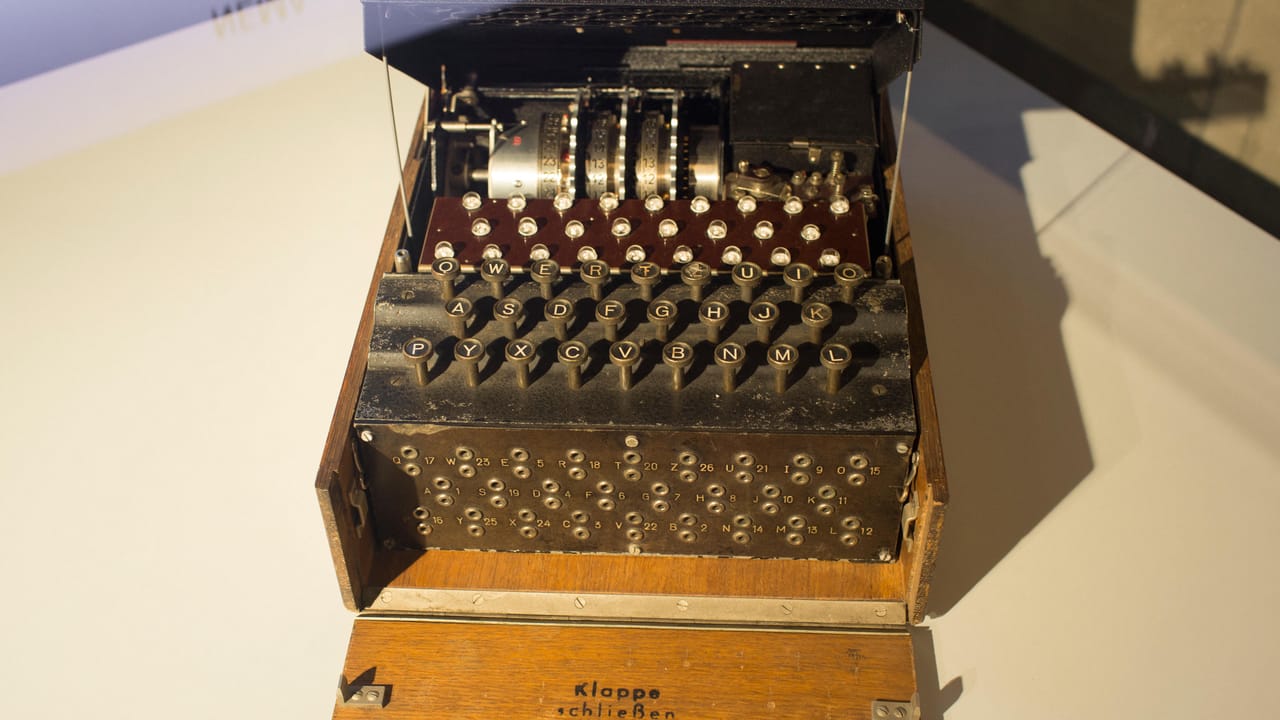
The Enigma cipher machine, a Nazi encryption device, is still relevant for modern cybersecurity professionals. Its history demonstrates critical failures like overconfidence, lack of testing, and human error that led to its code being broken. These lessons about operational security and the dangers of assuming invulnerability are directly applicable to defending against contemporary cyber threats. The device's enduring legacy will be highlighted in a presentation at the upcoming RSAC 2026 conference.
Enigma Cipher Device Still Holds Secrets for Cyber Pros
The Nazi relic's history is riddled with resilience errors, and those lessons still apply to defending against modern cyber threats.
Enigma cipher machines have endured in the minds of history buffs and cryptography hobbyists for more than a century, still discovered at dusty French flea markets and dredged up from under beach sludge by treasure hunters. And a dive at this year's upcoming RSAC Conference into lessons the Enigma can teach today's defenders suggests cybersecurity professionals should keep the history of the Nazis' hubris and failure of imagination in mind.
The Enigma machine was created by German Arthur Scherbius in 1918 as a way to protect sensitive information coming across telegraph lines for banks and business. A quirky-looking typewriter, it could be used to code and decode messages easily. Scherbius's device was subsequently nationalized and modified by the Nazis to add even more complexity to the cryptography, and was used with wild success in the German war effort — until 1932, when Polish cryptographers secretly broke the code. The Polish team didn't share their findings until 1939, when it was given to British Intelligence and sent to The Government Code and Cipher School at Bletchley Park, where it was put to work against the Nazi army and is credited as a huge contributor to the Allied Forces victory.
Marc Sachs, who is senior vice president and chief engineer of the Center for Internet Security and a collector of Enigma machines, estimates that anywhere between 35,000 and 40,000 Enigma machines were produced. But fleetingly few remain: maybe 350 to 360, according to Sachs. Many of the devices were obliterated along the way by German army rifle butts, then burned and buried in a hole, preferably a latrine, to keep them out of Allied hands, he explained.
"But they find a new one every couple of years," Sachs said from his home office, which contains two of these precious pieces of cybersecurity history. One is fully functional, but the other, found under the mud on a beach in Eastern France, likely dumped in a Nazi latrine in 1944, according to Sachs, is just cool to look at. Sachs had already secured his own Enigmas machines when interest in them surged with the 2013 release of the film "Imitation Game," about code-cracker and brilliant computer scientist Alan Turing and the war efforts at Bletchley Park.
"Then prices went through the roof," he said.
An original German Enigma machine. Source: Marc Sachs
More than just a collectible, Sachs said the history of the Enigma machine has quite a bit to teach today's cybersecurity professionals. During his upcoming presentation at RSAC 2026, he will weave through World War II history and outline the Nazi missteps that ultimately led to their communications compromise — without them ever suspecting such a compromise was possible.
The Enigma Machine's Cybersecurity Lessons
"There were engineering mistakes," Sachs said. "They trusted the design. There was no red teaming."
And, he added, Enigma's front-line users, who were, on average, 19-year-old rookie military recruits, were easily distracted and prone to laziness, creating their own vulnerabilities in the system.
"The Germans were over-confident," Sachs said. "They believed it couldn't be cracked, because they themselves couldn't crack it. But Polish intelligence intercepted messages and was able to do it."
Sachs' presentation will draw parallels between the Enigma machine and modern cybersecurity challenges around supply chain, scarcity of materials, and more. For hardcore enthusiasts, Sachs has arranged to have an Engima machine available at the RSAC's Moscone West, just ahead of his presentation, for people to check out for themselves.
RSAC Conference
Mar 23, 2026 TO Mar 26, 2026
Join thousands of your peers at RSAC™ 2026 Conference in San Francisco from March 23–26. Discover new strategies, explore bold technologies, and connect with peers who share your challenges and ambitions. Don’t just attend the Conference—be part of the community that defines what’s next.
 Meridiano