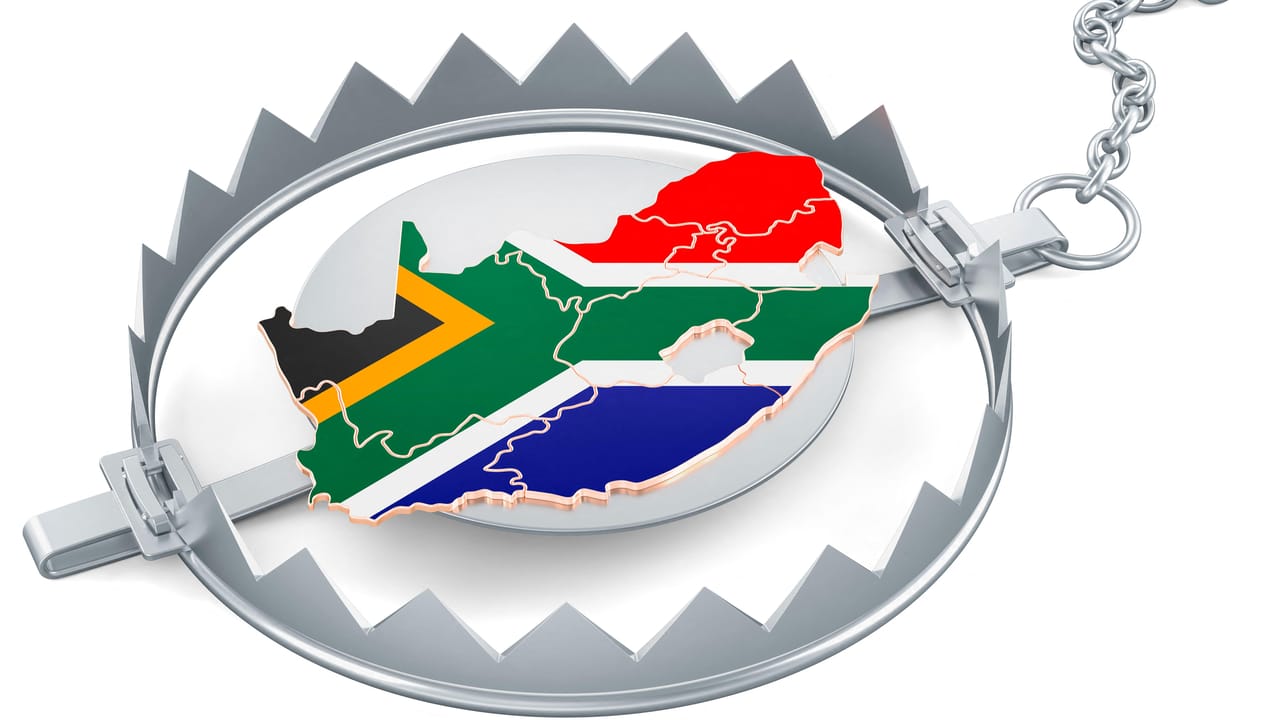
A 2025 report reveals that 77% of South Africans were scammed in a 12-month period, with 42% losing money, a rate far exceeding the global average. South Africans face an exceptionally high volume of scam attempts—roughly one every 36 hours—though the average financial loss per incident is lower than in wealthier nations. The article explains that scammers prioritize high-volume, low-friction targets in markets like South Africa, where digital defenses and awareness may be less mature, over richer but better-protected economies.
Breaking cybersecurity news, news analysis, commentary, and other content from around the world, with an initial focus on the Middle East & Africa and the Asia Pacific
More Than 40% of South Africans Were Scammed in 2025
Survey underscores the reality that scammers follow "scalable opportunities and low friction," rather than rich targets that tend to be better protected.
Africans lose money to scammers nearly twice as often as people from other countries do, according to recent survey data, and the financial costs in countries like South Africa are serious.
In October, the Global Anti-Scam Alliance (GASA) released its "Global State of Scams 2025 Report," based on quick online questionnaires taken by 46,000 adults in 42 countries. It found that during the preceding 12 months, 57% of citizens experienced some kind of scam and 23% of them lost money to one.
By comparison, on Feb. 11, GASA released a report solely focused on the data collected from South Africa. There, in the 12-month period leading up to early 2025, 77% of citizenss fell victim to a scam, and 42% of them lost real money as a result. Though an outlier on the global stage, the country is right in line with trends seen across Africa. According to GASA, around 41% of people on the African continent lost money to scams between the two survey periods.
Further, GASA explained it calculates the total amount lost per market by taking the average amount lost by respondents who reported losing money to a scam and extrapolating this to the wider adult population. "In our nationally representative sample of 1,000 respondents in South Africa, 42% reported having lost money to a scam. Among those affected, the average amount lost was $130.20 (R2,563.90)," the organization said. "Applying this incidence rate to the South African adult population (41,581,818; source: Statistics South Africa) suggests that approximately 17.5 million adults have been scammed."
South Africans Suffer Tons of Scams
Online scams in South Africa tend to involve less financial loss, in absolute terms, compared to most countries surveyed by GASA. The average scam victim in the US, for instance, loses just over $1,000 to their attackers, and in Austria that number approaches the equivalent of $3,000. In South Africa, it's more like $130.
It might come as some surprise then, that South Africa is one of the most targeted countries in the world. GASA found that the average number of scams faced annually in South Africa was 258 per person. That equates to roughly one attempt every 36 hours. Of the 42 countries included in its global report, South Africa ranked fifth on a list of where one is most likely to encounter scams on a daily basis.
"Generally, scammers don't optimize for the highest theoretical payout per victim; they optimize for ease, scale, and probability of success," says Patricia Eromosele, director of GASA's Africa Chapter. "A smaller payout that succeeds thousands of times is often more profitable than a large payout that rarely converts."
She explains, "In many lower-income or rapidly digitizing markets, fraud detection systems may be less mature, consumer awareness may be lower, and enforcement may be inconsistent, which increases conversion rates and reduces operational risk. At the same time, modern scams are highly automated and volume-driven, so attackers focus on where they can reach most people with the least resistance. Wealthier economies may offer higher potential payouts, but they also have stronger protections, better monitoring, and more aggressive prosecution. So, in practice, scammers tend to follow scalable opportunities and low friction rather than simply targeting where the most money exists."
With so many attacks to fend off, it's little wonder that so many South Africans eventually slip up. 98% of survey respondents indicated that they take at least one proactive measure to check whether some kind of offer they receive is real or fake, yet 77% fell for scams in the year leading up to their surveys, and those 77% succumbed to an average of not just one, but 2.2 compromises.
Eventually, all those compromises add up. Even with an average of $130 per scam, GASA extrapolated from its survey data that in a 12-month period, scammers earned around $2.3 billion by scamming South Africans more than 17.5 million times.
Law Enforcement Isn't Working
Just over 70% of South Africans who experienced scams reported them to their payment service providers, or the company behind whatever app they were using. Those rates are the lowest on the continent. Plus, they were only half as likely to report to law enforcement.
Among those who didn't report at all, the second most frequently cited justification was the belief that doing so would make no difference — that no action would be taken, anyway. That cynicism might have some merit. GASA's data suggests that around the globe, an average of 30% of scams that got reported resulted in the victim receiving at least some of their money back. In more affluent regions like North America and Europe, the number was relatively higher. The number was lowest in Africa, where only 20% of victims ever saw a financial benefit from reporting a scam they faced. In South Africa, that figure was 21%.
Victims might not see much enforcement action on their behalf, but law enforcement has been very visible lately in another respect. Particularly in Southeast Asia, national law enforcement agencies have been performing high-profile raids against scam compounds. Besides freeing the slave laborers who staff those compounds, theoretically, the raids should have an impact on the volume of online scams around the world.
Unfortunately, so far, the data isn't reflecting that. "We have not noticed any dent in scam activity, which continues to explode," Eromosele notes. "Of course, crackdowns matter as they disrupt operations and raise costs. But unless enforcement is coordinated across borders, activity doesn't disappear, it relocates."
"Scam networks operate regionally, while enforcement is still largely national. That asymmetry is the core vulnerability. We need the same level of real-time coordination on scams that we see in counterterrorism or anti-money-laundering. Moreover, this is a systems problem. And systems require coordinated reform, not isolated raids," she says.
In Eromosele's view, instead of raids that make for good news stories, law enforcement would do better to follow the money. "Arrests are visible. Asset seizures and sustained fund disruption are what actually change incentives," she argues. "The financial rails are the choke point. If funds can't move, the business model collapses."
Read more about:
DR Global Middle East & Africa
 Meridiano