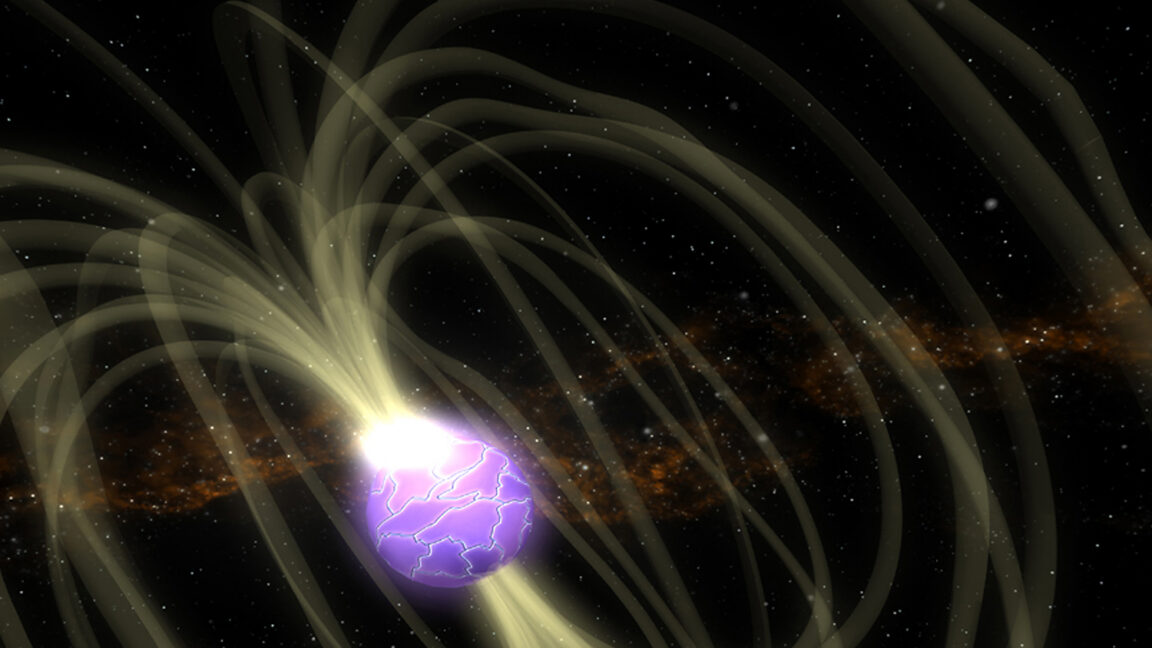
Astrophysicists have identified magnetars—rapidly spinning, highly magnetized neutron stars—as the most likely power source for extremely bright Type I superluminous supernovae. However, the standard magnetar model predicted a smooth brightening and fading of light, which did not match the observed "bumps and wiggles" in the supernovae's light curves.
Previous attempts to adjust the theory involved fine-tuned explanations like debris hitting irregular material shells or random magnetar flares. The core finding is that while magnetars are the leading candidate engine, the observed irregularities in the light output remain a puzzle not fully explained by the basic model.
The main topics covered are Type I superluminous supernovae, the magnetar engine theory, and the discrepancy between theoretical predictions and observed light curve data.
One of the most extreme explosions in the universe are Type I superluminous supernovae. “They are one of the brightest explosions in the Universe,” says Joseph Farah, an astrophysicist at the University of California Santa Barbara. For years, astrophysicists tried to understand what exactly makes superluminous supernovae so absurdly powerful. Now it seems like we may finally have some answers.
Farah and his colleagues have found that these events are most likely powered by magnetars, rapidly spinning neutron stars that warp the very space and time around them.
The power within
Magnetars have been a leading candidate for the engine behind superluminous supernovae. The theory says these insanely magnetized stars are born from the collapsing core of the original progenitor star and emit energy via magnetic dipole radiation. “This core is roughly a one solar mass object that gets crushed down to the size of a city,” Farah explains. As its spin slows down, a magnetar bleeds its rotational energy into the expanding material of the dead star, lighting it up.
The problem was, this theory did not quite explain observations. In a standard magnetar model, the light curve of the supernova should rise rapidly and then fade away evenly as the neutron star loses its rotational energy. “This way the light curve, in the prediction of this model, just goes up and then down quite smoothly,” Farah says. But when astronomers observe superluminous supernovae, they almost never see this smooth fade. Instead, they see bumps, wiggles, and strange modulations. The light curve flickers over months.
For a while, scientists tried to patch the magnetar engine theory so that it fit observations. Maybe the expanding debris was slamming into irregular shells of material shed by the star before it died. Or perhaps the magnetar engine was spitting out random, violent flares. But these explanations required highly specific fine-tuned parameters to match what we were seeing through our telescopes.
 Meridiano