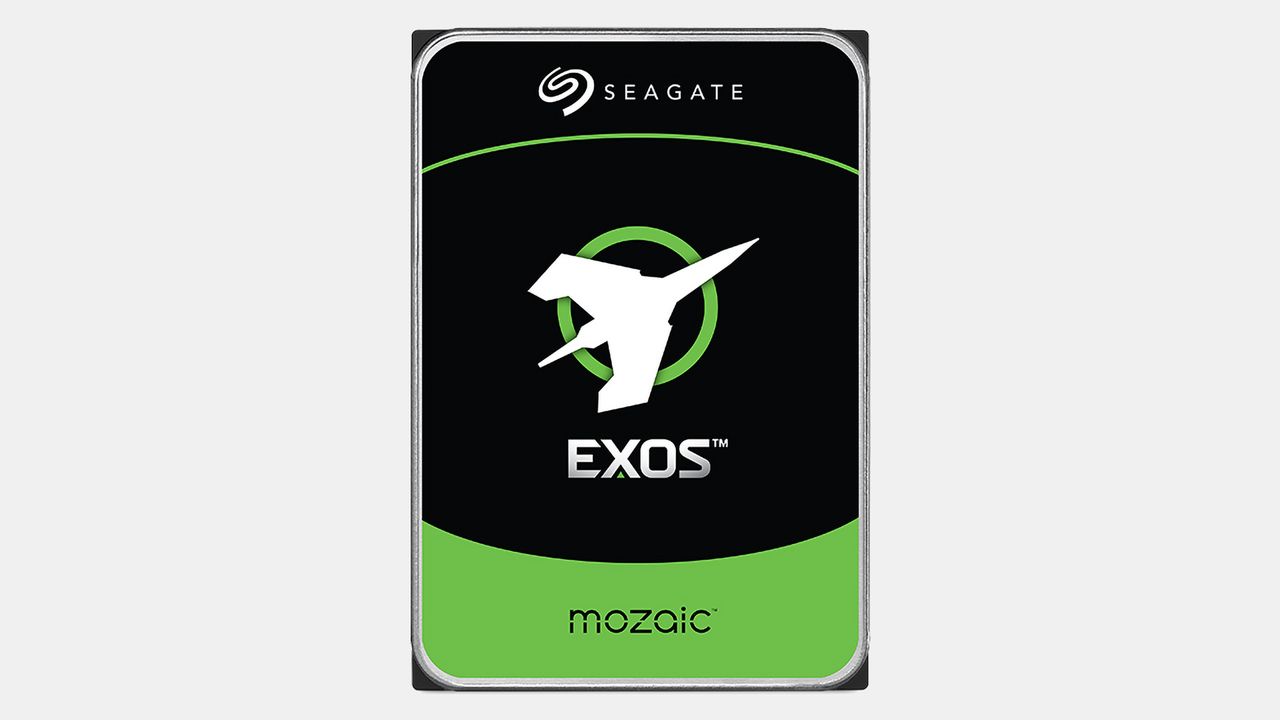
Seagate has begun shipping 44TB hard drives to select cloud service providers, marking a new capacity milestone. The drives are based on its Mozaic 4+ platform, which utilizes Heat-Assisted Magnetic Recording (HAMR) technology and 10 platters to achieve this density.
The announcement appears timed to counter rival Western Digital's planned 40TB drives, with Seagate positioning its HAMR technology as more advanced. The company also emphasizes the new drives' efficiency, claiming they can significantly reduce the physical footprint and power consumption of data centers when deployed at scale.
Main topics: Seagate's 44TB HDD shipment, the Mozaic 4+ and HAMR technology, competitive landscape with Western Digital, and the efficiency benefits for data centers.
Seagate begins shipping 44TB hard drives with HAMR tech to data centers — Mozaic 4+ platform expands to 10 platters
Hard drives hit an important 44TB capacity milestone.
Get Tom's Hardware's best news and in-depth reviews, straight to your inbox.
You are now subscribed
Your newsletter sign-up was successful
Seagate has announced that it has begun shipments of its latest hard disk drives featuring a 44TB capacity to two of its partners among the leading hyperscale cloud service providers (CSPs). The new HDDs are based on the company's Mozaic 4+ platform that relies on Seagate's heat-assisted magnetic recording (HAMR) technology.
Seagate's Mozaic 4+ platform uses 10 platters with up to 4+ TB capacity per platter to enable drives of up to 44TB. The drives are believed to feature a 7200 RPM spindle speed as well as conventional magnetic recording (CMR) and therefore offer predictably high performance by HDD standards: think sustained data transfer rates of around 300 MB/s, though we are speculating.
Normally, Seagate and other makers of HDDs tend to release a lineup of hard drives offering different capacity points upon formal launch. With its Mozaic 4+ platform, Seagate is changing its tactics and only formally introduce its 44TB HDD that is currently being shipped to just one hyperscaler. Other large CSPs are currently qualifying Mozaic 4+-based drives, though we do not know which capacity points we are talking about.
Perhaps, the main reason why Seagate disclosed shipments of its 44TB HDDs now is the fact that its arch-rival Western Digital announced plans to ship its 40TB hard drives in the second half of the year. Unlike Seagate's Exos 44TB HDDs, Western Digital's 40TB drive does not rely on HAMR technology. Instead, it uses energy-assisted magnetic recording (EAMR) and UltraSMR technology that greatly expands capacity at the cost of slow overwrite performance. By making this announcement now, Seagate sends its potential customers a clear message that its HAMR-based hard 44TB drives are more technologically advanced than WD's 40TB offerings.
While the difference between 40TB and 44TB may seem immaterial, when deployed at scale, that difference may become significant when power consumption per TB is considered. Seagate compares its 44TB offering to 30TB drives and claims that the new drives increase overall system efficiency by roughly 47%, which enables hyperscalers to shrink physical footprint of their storage clusters by around 100 square feet while trimming annual power consumption by approximately 0.8 million kilowatt-hours.
"Data has become one of the most valuable assets for enterprises, fueling business insights, enhancing productivity, and enabling competitive advantage," said Dave Mosley, Seagate's chair and chief executive officer. "As the foundation of modern data center infrastructure, data storage solutions are essential to manage ever-increasing data volumes and maximize returns on investments in today's AI driven-world. Seagate's HAMR-based Mozaic products deliver the scale, performance, and efficiency customers need to unlock the full potential of their data"
Follow Tom's Hardware on Google News, or add us as a preferred source, to get our latest news, analysis, & reviews in your feeds.
Get Tom's Hardware's best news and in-depth reviews, straight to your inbox.
Anton Shilov is a contributing writer at Tom’s Hardware. Over the past couple of decades, he has covered everything from CPUs and GPUs to supercomputers and from modern process technologies and latest fab tools to high-tech industry trends.
 Meridiano