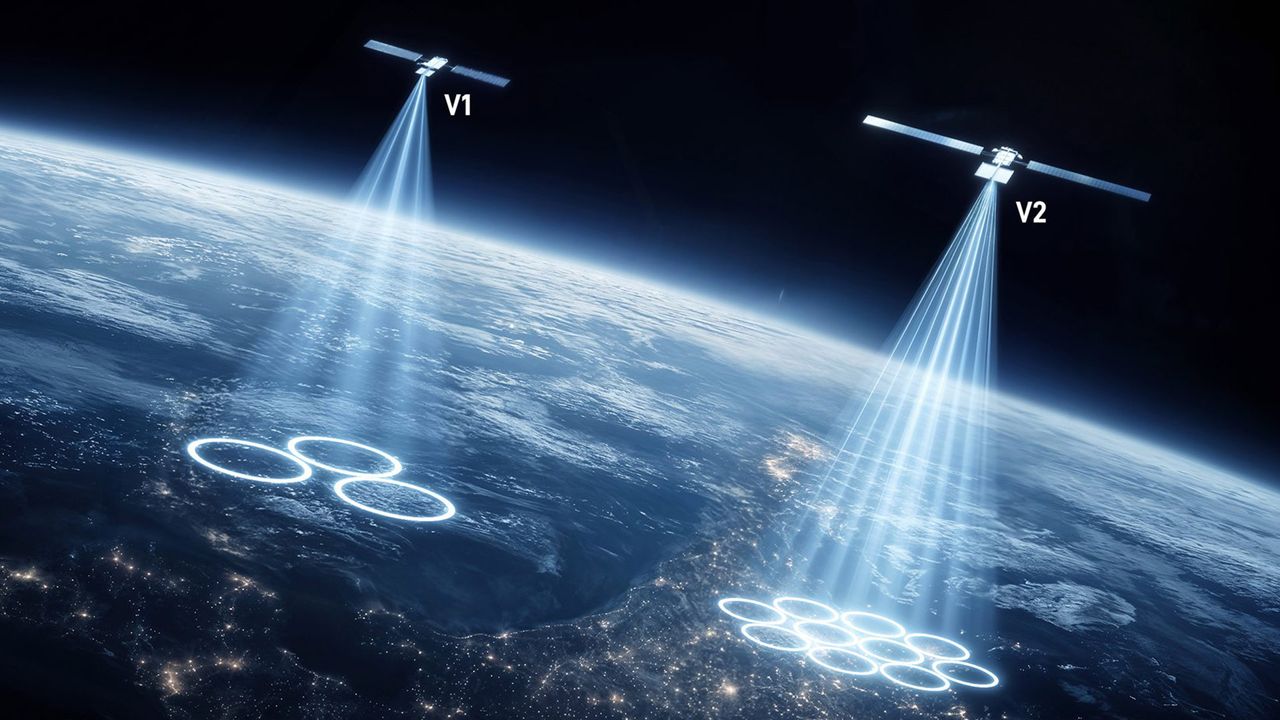
Starlink Mobile has announced a major performance upgrade for its satellite-to-phone service, promising "5G speeds from space" and 100 times the data density of its current V1 satellites. This enhancement, powered by next-generation V2 satellites, aims to enable seamless streaming, browsing, and voice calls, moving beyond the current service limited to light data and texts.
The upgraded service is not expected to begin rolling out until 2027, pending the deployment of sufficient V2 satellites into orbit by SpaceX. The technology is designed to be compatible with hundreds of existing LTE phones and to work with terrestrial partners for smooth transitions between satellite and cellular networks.
The main topics covered are the announced performance upgrade for Starlink Mobile, the role of the new V2 satellites, the expected timeline for rollout, and the service's compatibility with existing devices and terrestrial networks.
Starlink Mobile teases ‘5G speeds from space with 100x the data density’ — V2 satellites are being sent into orbit to power the upgrade
We don’t have a date for the upgraded service rollout, but it isn't likely until 2027.
Get Tom's Hardware's best news and in-depth reviews, straight to your inbox.
You are now subscribed
Your newsletter sign-up was successful
Starlink’s official social media channels are boasting about an incredible performance update on the way to mobile customers. A Tweet on Sunday claimed that the next-gen V2 satellites being launched by SpaceX would deliver “100x the data density of the current V1 generation satellites.” That’s the kind of upgrade multiplier anyone can appreciate.
Starlink Mobile’s next-gen satellites will deliver 5G speeds from space with 100x the data density of the current V1 generation satellitesV2 satellites will seamlessly enable streaming, internet browsing, high-speed apps and voice calls, just like being connected to a… pic.twitter.com/ObPjtv0eECMarch 2, 2026
The announcement will affect the Starlink Mobile service, which was previously branded as ‘Direct to Cell’ until recently. Whatever the moniker, this service provides satellite-to-phone communications – data, voice, messaging – across 32 countries spanning six continents. When enough V2 satellites get into LEO position, we’d say these “cellphone towers in space” are going to boost the service quality significantly.
The Starlink Direct to Cell, now Starlink Mobile, service only began to roll out commercially last July. However, compared to traditional mobile service providers, its only real draw is the inherent ‘connectivity where you need it’ and emergency coverage where space-based comms beat those on Earth.
100x, 20x, what the x?
Starlink Mobile’s current service, using V1 satellites, is currently only good for ‘light data’ and texts, according to a number of mobile-centric sites. Thus, the upgrade to V2 is going to be significant.
Putting some numbers to the claims, we see that the V2 upgrade is touted to deliver ‘5G from space,’ which is also compatible with 100s of existing LTE phones. Don’t get the 100x and 20x claims seen across Starlink social media and web pages mixed up. The V2 satellites upgrade is said to provide “100x the data density” compared to the current V1 satellites, with “around 20x the throughput capability” per satellite.
Starlink also expects terrestrial operator partners, like T-Mobile in the U.S., to provide services which “seamlessly transition between satellite and terrestrial networks without interruption or degradation in service.” Previous Starlink announcements point to a goal of peak speeds of 150 Mbps per user becoming realistic with the rollout of the V2 satellites.
SpaceX is currently planning up to 15,000 new satellites to power its ‘5G from space’ goal. Starship’s progress at putting the larger, more capable V2 satellites into space will impact the availability window of the enhanced service, but some V2 Mini satellites are already being launched to help bridge the gap.
Get Tom's Hardware's best news and in-depth reviews, straight to your inbox.
Thus, early 2027 looks most likely to be when the initial V2 service will be tested in the early rollout stage.
Follow Tom's Hardware on Google News, or add us as a preferred source, to get our latest news, analysis, & reviews in your feeds.
Mark Tyson is a news editor at Tom's Hardware. He enjoys covering the full breadth of PC tech; from business and semiconductor design to products approaching the edge of reason.
-
gggplaya I think most smartphone users would be perfectly fine with 10mbps when you're out in the middle of nowhere with zero cell reception. It's plenty more than enough for 1080p content.Reply
If you're out in a cabin or camper trying to use a computer, you should probably use normal Starlink anyways. -
Geef I like the fact that it's not an upgrade issue for people on the ground. All the hardware is already there for people using it.Reply
You won't need to go buy a new 'cable modem' to get faster speeds. :mad: -
Findecanor I am not sure about this...Reply
I'm afraid of Kessler Syndrome being achieved within my lifetime. -
hushnecampus Reply
Ditto. Well, I have two concerns: 1. it's not sustainable to get a single compony responsible for this service, it needs competition, and 2. when that competition takes of (no pun intended) what happens to the likelihood of collision? I don't have a clue whether that would put us into KS territory, we could still be orders of magnitude off for all I know (or we could already be on the verge).Findecanor said:I am not sure about this...
I'm afraid of Kessler Syndrome being achieved within my lifetime. -
GenericUser2001 Reply
Starlink satellites are way too low for Kessler Syndrome to be a concern; they are actually moving all their satellites even lower this year to be extra safe (mostly from Chinese operators who are not the best at announcing where their stuff will be).Findecanor said:I am not sure about this...
I'm afraid of Kessler Syndrome being achieved within my lifetime.
 Meridiano