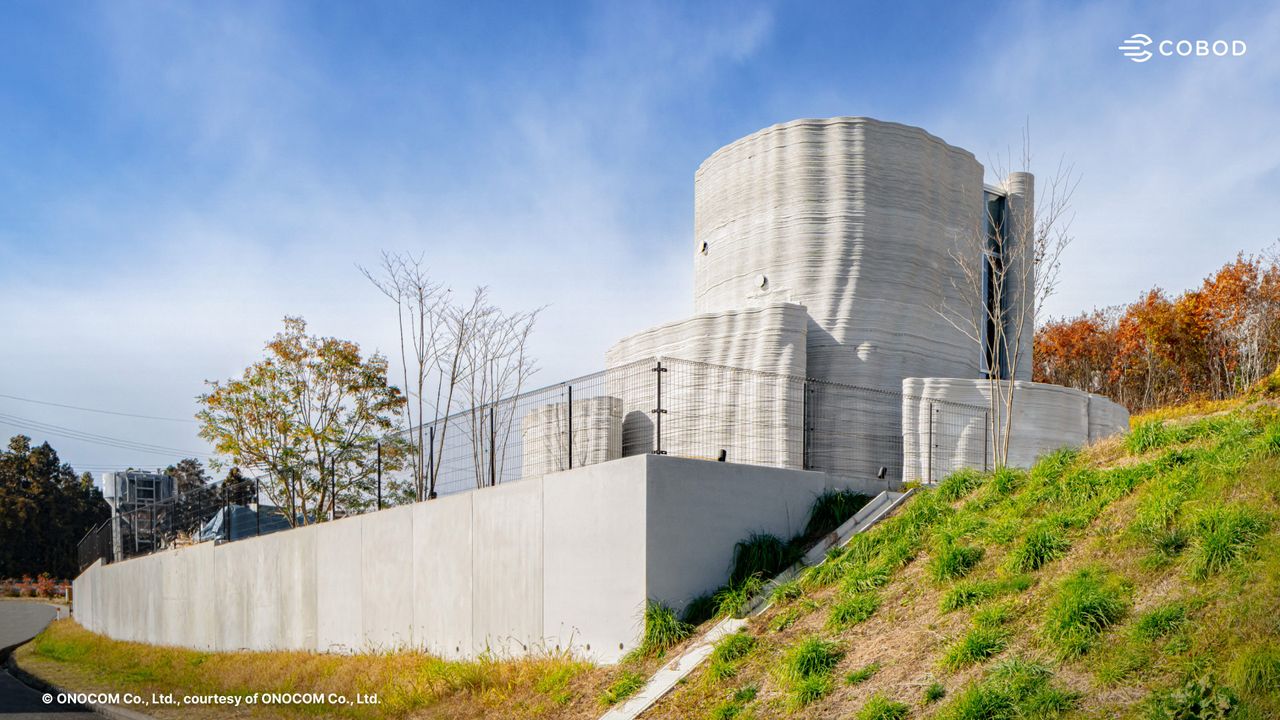
Japan has completed its first government-approved, two-story 3D printed house, marking a significant milestone for seismic-resistant construction. The cave-inspired home was printed on-site using COBOD's technology, demonstrating the method's ability to meet Japan's strict earthquake regulations and handle complex designs.
The construction process eliminated traditional formwork and reduced transport costs and CO2 emissions, while also proving resilient to varying weather conditions during printing. The successful project highlights 3D printing's potential for creating structurally sound, multi-story buildings in earthquake-prone regions.
Main topics: 3D printed construction, seismic compliance/earthquake resistance, building technology and process benefits, project collaboration in Japan.
Cave-inspired 3D printed Japanese home touted as earthquake resistant — two-story house first of its kind to be granted seismic compliance certificate
Most of the structure was 3D printed using COBOD’s BOD2 construction printer.
Get Tom's Hardware's best news and in-depth reviews, straight to your inbox.
You are now subscribed
Your newsletter sign-up was successful
Construction of the first government-approved two-story 3D printed home has been completed in Japan. Understandably, the land of the rising sun has stringent seismic compliance regulations, so this is a big milestone for the 3D Construction Printers (3DCP) business and the housing market.
COBOD, which claims to be the “world leader in 3D construction printing solutions,” said its 3DCP system was used for this “cave-inspired” architectural wonder. The actual on-site home building/fabrication work was executed by Kizuki Co., Ltd in Kurihara City, Miyagi Prefecture, Japan. Meanwhile, the eye-catching design of this two-story dwelling was likely steered by project collaborator Onocom, an architectural services company.
“Japan has some of the most demanding seismic requirements in the world. Seeing a government-approved two-story 3D printed reinforced concrete house completed here confirms that 3D construction printing is ready for projects that rely on structural precision and consistent quality, also in seismic areas,” commented Henrik Lund-Nielsen, Founder and General Manager of COBOD International. “The collaboration demonstrates how our technology handles complex geometry, varying climate conditions, and strict regulatory standards.”
Indeed, this house was built from the ground up, relying heavily on a single 3DCP. Onocom notes (machine translation) that 3D printed buildings have typically been limited to small-scale or single-story structures. The successful fabrication of a fully seismic-compliant dwelling of two stories makes it even more notable. ‘Multifunctional wall’ segments, “molded in one step to create a three-layer structure that integrates design, structural frame, and facility space,” are said to drastically reduce on-site post-processing.
Other touted benefits of the 3DCP process used to build this cave-inspired home in Kurihara City are: the elimination of construction formwork, reduction of cost and CO2 from parts transport, design freedom, stable quality control, the ability to print continuous foundations for strength, and a boost in speed of construction.
Last but not least, the project also confirmed the tolerance of 3DCP to variable weather and temperature conditions. COBOD says that the initial formwork for the house was printed at temperatures below 10 °C (50 °F), requiring heated mixing water to maintain printability. In contrast, the main house structure was completed in summer at a rather toasty 30–35 °C (86–95 °F). High environmental temperatures “shortened bucket life and required careful process control,” but these hurdles didn’t interrupt or impair the 3D printer-driven building process.
Follow Tom's Hardware on Google News, or add us as a preferred source, to get our latest news, analysis, & reviews in your feeds.
Get Tom's Hardware's best news and in-depth reviews, straight to your inbox.
Mark Tyson is a news editor at Tom's Hardware. He enjoys covering the full breadth of PC tech; from business and semiconductor design to products approaching the edge of reason.
-
coolitic Looks quite ugly from the outside; but I suppose the inside does have a palatable "cave" aesthetic.Reply -
sadsteve I'd be plastering and painting the walls before I'd move in. Look like you could lose some skin against those walls when you moved your furniture upstairs.Reply -
thrus So what do they use to clean the walls inside? It would spread most towles, brooms, sponges. A pressure washer would work but most people would not be all for pressure washing their living room after they take all the furniture out and turn off power to the outlets, a bit to much work.Reply
 Meridiano