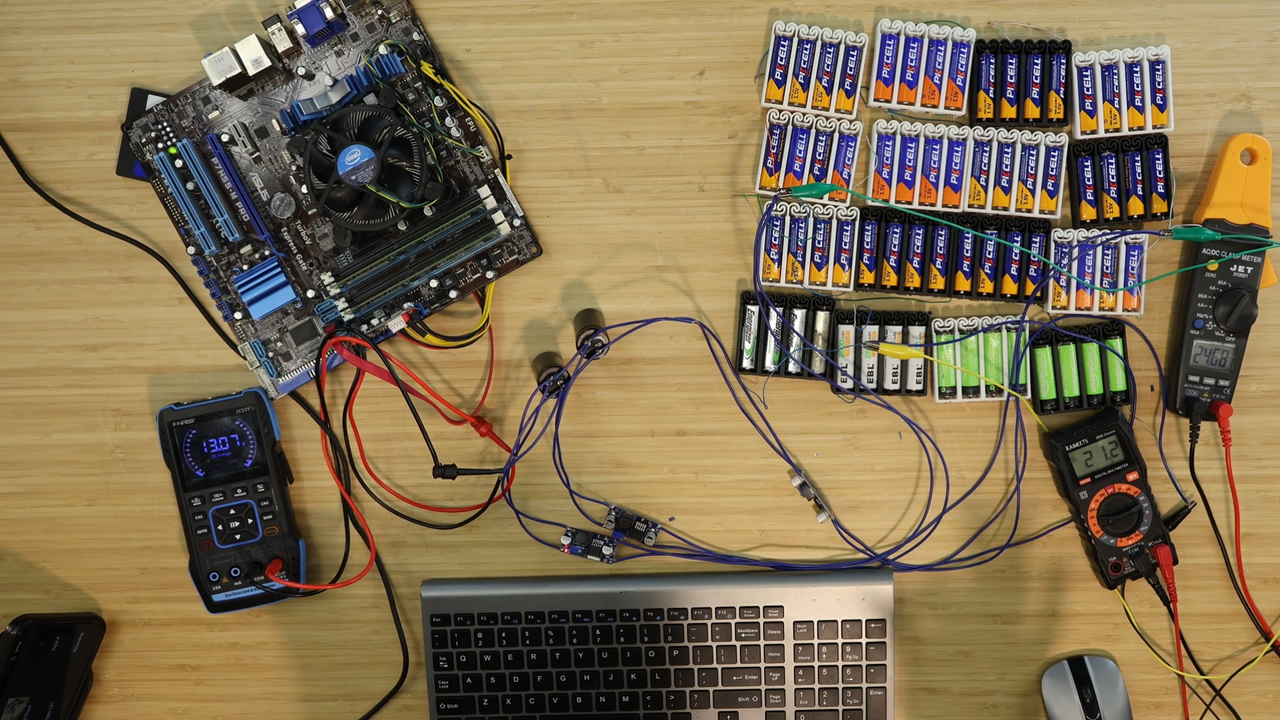
An enthusiast named ScuffedBits successfully powered a desktop PC for over 30 minutes using 64 AA batteries. This was achieved by modifying battery pack wiring to output 25 volts and using three parallel voltage regulators to provide a stable 12 volts to the system.
The modified setup allowed the PC, featuring an Intel Core i3-530 processor, to boot independently and run benchmarks and games like Minecraft. The project improved upon a prior attempt that lasted only five minutes by addressing issues like high resistance in wiring.
The experiment is presented as a fun, non-practical project, highlighting the technical challenge overcome rather than proposing a viable power solution. A car battery was also tested for comparison, easily powering the system for hours.
Main topics: A hobbyist's technical project, modifications for stable power from batteries, and the system's performance and duration during testing.
Enthusiast rebuilds AA-battery-powered PC, sextuples run time to 30 minutes with 64 batteries — uses three voltage regulators in parallel to achieve stability, runs computer for over 30 minutes on 64 AA cells
Imagine buying huge boxes of AA batteries just to use your laptop for one day.
Get Tom's Hardware's best news and in-depth reviews, straight to your inbox.
You are now subscribed
Your newsletter sign-up was successful
Creator and enthusiast ScuffedBits successfully ran a desktop PC for about five minutes on AA batteries alone and was even able to complete one round of Minesweeper on it. However, it seemed that that wasn’t long enough, so he decided to redo the project, intending to address the problems of the first build.
The biggest issue they fixed first was the high resistance of the tiny wires used to connect the batteries to the motherboard. Instead of replacing them, ScuffedBits modified the wiring of the battery packs to get around 25 volts, meaning that the PC would now require lower current, preventing instability because of the thin wiring. Of course, 25 volts isn’t good for the motherboard, so they also added three voltage regulators wired in parallel to get a consistent 12 volts until the batteries died. To further ensure that the system works, they also eliminated the alligator clips and soldered the wires directly to the capacitors that came from the original project.
With everything in place, ScuffedBits inserted the last three AA batteries, completing the circuit and bringing the PC to life. Unlike the last time, which needed an external power source to “jumpstart” the computer, it was able to boot straight up using just the AA cells this time. With the voltage holding steady, they were able to log into Windows and show us the specifications of the PC — an Intel Core i3-530 paired with 8GB of RAM and a WD SATA SSD.
Article continues belowThe first thing they did was play one round of A Short Hike, which they finished some three and a half minutes after turning on the computer purely on AA batteries. But what’s more interesting was that they were able to run Cinebench on the system, pushing the rather old CPU to its limits. Even though this processor is rather old, TechPowerUp reports that it still has a power draw of 73 watts. Nevertheless, the system completed the test almost eight minutes after booting up, with no signs of slowing down.
So, after the benchmark, ScuffedBits decided to install Minecraft and play several rounds of Party Games. After that, he tried to install Portal 2, but the system finally died after 33 minutes and 19 seconds — quite a remarkable feat for a home-made AA-battery power solution for a desktop PC. This isn’t groundbreaking technology, especially as we have better battery solutions available to us nowadays. Besides, who would want to purchase 64 AA batteries at a gas station multiple times a day just to keep their laptops fully charged?
The creator also ran a test using a 12-volt car battery on the system, showing that it will work. But they also said that it was going to be quite boring, as the car battery should have enough juice to run the desktop computer for three to four hours without any problems. Nevertheless, the entire thing is still a fun project, tinkering with batteries and PCs, and we hope to see more similarly crazy experiments from ScuffedBits in the future.
Follow Tom's Hardware on Google News, or add us as a preferred source, to get our latest news, analysis, & reviews in your feeds.
Get Tom's Hardware's best news and in-depth reviews, straight to your inbox.
Jowi Morales is a tech enthusiast with years of experience working in the industry. He’s been writing with several tech publications since 2021, where he’s been interested in tech hardware and consumer electronics.
 Meridiano