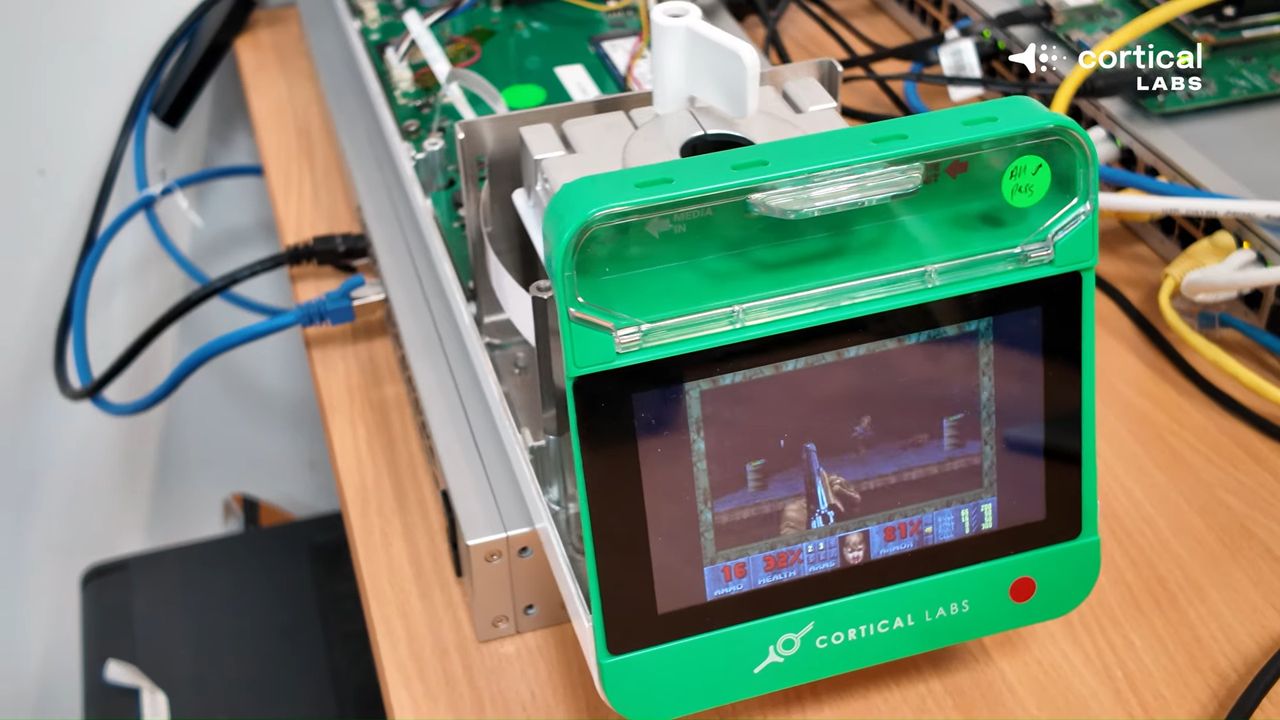
Australian biotech company Cortical Labs has demonstrated its CL1 biological computer, which uses approximately 200,000 living human neurons on a microchip, successfully playing the video game Doom. This represents a significant advancement from its previous demonstration playing Pong, as Doom's 3D environment is far more complex.
The system works by converting the game's video feed into patterns of electrical stimulation, which the neurons learn to associate with specific in-game actions like moving and shooting. Researchers highlight this as a demonstration of "adaptive real-time goal-directed learning," though they note the system is not yet highly proficient.
The project's complexity inspired the development of the 'Cortical Cloud' for training, and the company is now inviting developers to use its open API to build upon the technology.
Main Topics: Cortical Labs, CL1 biological computer, human neurons on a microchip, playing Doom, neural learning and interface, Cortical Cloud.
‘200,000 living human neurons’ on a microchip demonstrated playing Doom — Cortical Labs CL1 video shows the gameplay and explains how the neurons learn the game
Doom game training also inspired the creation of the ‘Cortical Cloud.’
Get Tom's Hardware's best news and in-depth reviews, straight to your inbox.
You are now subscribed
Your newsletter sign-up was successful
Australia’s Cortical Labs has demonstrated its 'body in a box' CL1 biological computer playing Doom. A video showing the Doom gameplay, and explaining the processes behind this feat was shared by the research and development team. In the video intro, it is claimed that “around 200,000 living human neurons on a microchip” were used to power the seminal FPS action.
We reported on the Cortical Labs CL1 launch last year. The biotech company behind “the world’s first code deployable biological computer” was very bullish about their combination of human brain cells with traditional silicon-based computing. Shipments of CL1 computers were scheduled for June of the same year.
Previously, the CL1 development team had demonstrated the neurons playing the pioneering arcade game Pong, but internet users bombarded Cortical Labs with requests for Doom (of course). Now, Doom has been demonstrated being played by the mass of neurons.
“Doom was much more complex,” explained Dr. Brett Kagan in the video. Its 3D labyrinths, enemies, weapons, etc., make it several degrees more advanced than Pong. This complexity inspired the ‘Cortical Cloud’ for training more complex tasks.
“Together with one of our collaborators, an independent researcher named Sean Cole, we coded the first working version of Doom using the Cortical Labs API, and running on a CL1,” said Dr. Alon Loeffler of c, who presented this demo video. Kagan added that the demo showed “adaptive real-time goal-directed learning” in action.
Company CTO David Hogan explains that Sean Cole managed to pipe the “video feed from the game into patterns of electrical stimulation” and, in that way, the neurons could feel the action. So, for example, if the neurons fire in a specific learned pattern, the Doom guy shoots, and another pattern will prompt him to move position. This way, the brain cells can find enemies, shoot them, and then progress.
Not an eSports champion - yet
This is impressive to see, but “Is it an eSports champion? Absolutely not,” states Kagan, employing some rhetoric. Importantly, though, “they are learning,” and feedback for the right and wrong actions needs to be refined. Nevertheless, Cortical Labs is happy it has “solved the interface problem” to interact with the brain cells in real-time, and then train them and shape their behavior. This is why the CL1 was designed. And it is hoped the CL1 will be able to soon excel at Doom gaming, and then take on ever-increasingly complex tasks.
Get Tom's Hardware's best news and in-depth reviews, straight to your inbox.
The video ends with a call to developers and researchers to come and interact with the open Cortical Labs CL1 API – to see what they can build. “The neurons are ready.”
Follow Tom's Hardware on Google News, or add us as a preferred source, to get our latest news, analysis, & reviews in your feeds.
Mark Tyson is a news editor at Tom's Hardware. He enjoys covering the full breadth of PC tech; from business and semiconductor design to products approaching the edge of reason.
-
-Fran- This is interesting, but I have to ponder: isn't the whole point of making machines not biological about removing the fragility (as much as possible) of humans? Did they quote a failure rate for their prototypes?Reply
I say this, because to my understanding neurons are very fragile in the human body (hence why whacking someone in the head is not a good thing). Humans compensate, somewhat, by having quite a lot of them: ~85000 million with a quick search.
Still, it doesn't take away the amazingness of it. I look forward to the medical applications of this.
Regards. -
Spuwho They aren't recreating the biological neurons physically, they are reproducing them digitally. So the "hit in the head" argument is not quite analogous. They are attempting to impress human engrams that are based on bio-neural pathways onto silicon. By playing Doom, they are baselining the capabilities of their work. Technically they could attempt to recreate any mammal since they all use bio-neural driven brain processing, but we haven't developed ways to test them because humans don't know how all mammals think. What is deduced, what is experiential, and what is instinctual.Reply -
-Fran- Reply
Thanks for the clarification. Very badly named tech then :DSpuwho said:They aren't recreating the biological neurons physically, they are reproducing them digitally. So the "hit in the head" argument is not quite analogous. They are attempting to impress human engrams that are based on bio-neural pathways onto silicon. By playing Doom, they are baselining the capabilities of their work. Technically they could attempt to recreate any mammal since they all use bio-neural driven brain processing, but we haven't developed ways to test them because humans don't know how all mammals think. What is deduced, what is experiential, and what is instinctual.
Regards. -
80251 Reply
So they aren't "living neurons" at all, because they're not alive.Spuwho said:They aren't recreating the biological neurons physically, they are reproducing them digitally. So the "hit in the head" argument is not quite analogous. They are attempting to impress human engrams that are based on bio-neural pathways onto silicon. By playing Doom, they are baselining the capabilities of their work. Technically they could attempt to recreate any mammal since they all use bio-neural driven brain processing, but we haven't developed ways to test them because humans don't know how all mammals think. What is deduced, what is experiential, and what is instinctual.
I have to admit I was curious as to how they would keep biological cells alive in a silicon substrate. -
bit_user Reply
No, this is incorrect. The article is pretty explicit that these are biological neurons. If there was any doubt, the article links to a prior piece which explains more about the setup.Spuwho said:They aren't recreating the biological neurons physically, they are reproducing them digitally.
https://www.tomshardware.com/tech-industry/worlds-first-body-in-a-box-biological-computer-uses-human-brain-cells-with-silicon-based-computing
You can also click through the image carousel to see a few other pics:
FWIW, I doubt the brain organoid is being fed raw pixel data. I think it must be preprocessed in some way. It's not nearly enough neurons to perform simple vision tasks. -
bit_user Reply
Their website says "Real neurons are cultivated inside a nutrient rich solution, supplying them with everything they need to be healthy." !80251 said:So they aren't "living neurons" at all, because they're not alive.
I have to admit I was curious as to how they would keep biological cells alive in a silicon substrate.
https://corticallabs.com/cl1.html
Did it ever occur to you or @-Fran- to go back and check the article, when somebody (esp. with no sources or references) contradicts it? -
bit_user Reply
A human brain has about 90 billion neurons. This has 200k. That's almost a 6-order-of-magnitude difference!patriotpa said:Since when is it legal to play with human brain tissue?
So, it's definitely not thinking. It's just on par with something like a simple insect. -
-Fran- Reply
It did, but I'm lazy like that.bit_user said:Their website says "Real neurons are cultivated inside a nutrient rich solution, supplying them with everything they need to be healthy." !
https://corticallabs.com/cl1.html
Did it ever occur to you or @-Fran- to go back and check the article, when somebody (esp. with no sources or references) contradicts it?
Plus, I know you're around :P
Regards. -
80251 Neurons can live for 90 years. I'd like to see proof that this biological device can do anything useful and for $35k they'll need some independent proof to convince me.Reply
 Meridiano