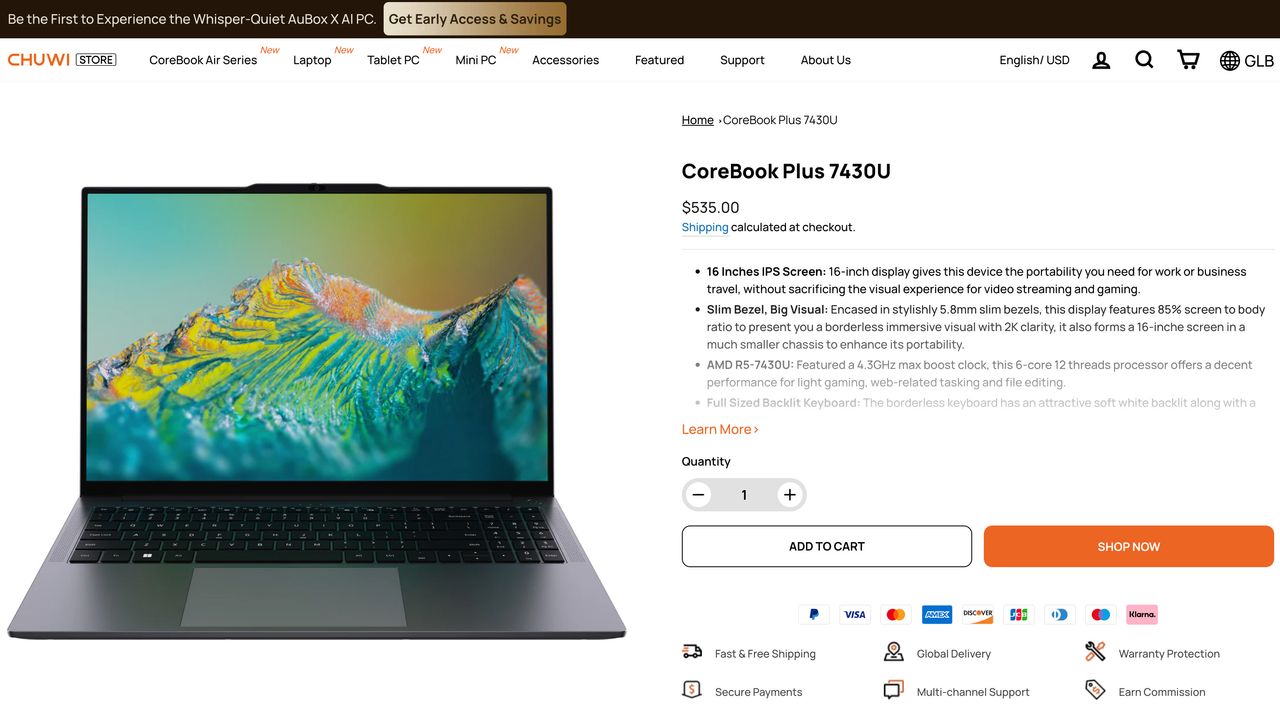
News outlet Notebookcheck has discovered that Chuwi is selling laptops, specifically the CoreBook X and CoreBook Plus, advertised with newer AMD Ryzen 5 7430U processors that actually contain older, slower Ryzen 5 5500U chips. The substitution is not a simple labeling error, as evidence shows the processors are deliberately spoofed at a firmware level to falsely report as the newer model in system software.
Chuwi initially downplayed the issue as a batch mix-up but later reportedly threatened legal action against the publication to remove the story. The older 5500U chip offers notably lower performance and is cheaper to produce, raising serious questions about supply chain integrity and whether this is a deliberate cost-cutting measure by Chuwi or a failure of its quality control.
The main topics covered are a consumer electronics scandal involving fraudulent hardware specifications, corporate accountability and response, and supply chain integrity issues.
Get Tom's Hardware's best news and in-depth reviews, straight to your inbox.
You are now subscribed
Your newsletter sign-up was successful
The Ryzen 5 7430U may not be one of the best CPUs, but that doesn't mean you can swap it for an older and slower chip from a previous generation without anyone noticing. News outlet Notebookcheck has unearthed yet another Chuwi laptop that reportedly comes with a different processor that doesn't match its advertised specifications. What started as an isolated event with a single model appears to just be the tip of the iceberg.
The initial scandal centered on the CoreBook X, a laptop marketed as featuring the Ryzen 5 7430U processor. However, a teardown revealed that the device actually contained an older, less powerful Ryzen 5 5500U. Chuwi attempted to downplay the controversy, suggesting the mix-up was due to differing production batches and leftover stock on the market. Yet mounting evidence pointed to deliberate tampering somewhere in the supply chain, in which the processor had been intentionally altered to mimic a newer Ryzen chip.
According to Notebookcheck, Chuwi reportedly demanded the publication remove its article around the scandal, seemingly accompanied by threats of legal action over alleged reputational damage. The incident ignited widespread concern about the authenticity of processors in Chuwi devices. and fueled the news outlet to dig deeper.
Article continues belowThe publication purchased a CoreBook Plus, another laptop boldly advertised as leveraging the Ryzen 5 7430U processor, from a reputable German retailer. The findings were consistent with the CoreBook X model. The sticker with the specifications on the packaging blatantly shows the Ryzen 5 7430U. There's a matching Ryzen 7000 series sticker on the laptop, which is false since the Ryzen 5 5500U belongs to the Ryzen 5000 series.
As expected, the processor was showing as the Ryzen 5 7430U inside the CoreBook Plus's BIOS, in Windows, and in system information and monitoring utilities, including CPU-Z. A quick disassembly shows that the processor carries the 100-000000375 OPN number, which we already know corresponds to the Ryzen 5 5500U. The Ryzen 5 7430U's OPN is 100-000000943.
Consumers, who are well-versed in processors, can easily tell the Ryzen 5 5500U and the Ryzen 5 7430U apart. The devil is in the details, but less-informed buyers may not be able to tell them apart due to their similarities. However, remember that the two-year-older Ryzen 5 5500U has lower boost clock speeds (200 MHz lower base and 300 MH lower boost) and half the L3 cache capacity of the Ryzen 5 7430U. Performance-wise, the Ryzen 5 7430U is, on average, about 7% faster than the Ryzen 5 5500U, but as Notebookcheck has highlighted, the performance delta can climb to 20% in certain workloads.
With irrefutable evidence emerging from two distinct Chuwi laptop models, the notion that this is merely a case of mislabeling has become impossible to defend. The level of manipulation doesn't happen by accident, as someone spoofed the processor on a firmware level. While some might argue that both the CoreBook X and CoreBook Plus could be from the same "defective" batch, it's unlikely. Notebookcheck’s photographs confirm that the two devices utilize entirely different motherboards, ruling out any production error.
Get Tom's Hardware's best news and in-depth reviews, straight to your inbox.
Chuwi offers the CoreBook Plus 7430U with 16GB of memory and a 512GB SSD for $535, placing it within the $450–$550 range typical for similarly specced devices in the U.S. market. So, it's not the most affordable device out there. Being an older chip, the Ryzen 5 5500U is logically cheaper to produce. This raises the question whether Chuwi is pulling a switcheroo to increase profits or if its supplier is pulling a fast one on the company. If the latter, Chuwi urgently needs to strengthen its quality control measures.
Follow Tom's Hardware on Google News, or add us as a preferred source, to get our latest news, analysis, & reviews in your feeds.
Zhiye Liu is a news editor, memory reviewer, and SSD tester at Tom’s Hardware. Although he loves everything that’s hardware, he has a soft spot for CPUs, GPUs, and RAM.
 Meridiano